On 17 September 2026 the European Medicines Agency's human medicines committee recommended Biocon's pertuzumab biosimilar, Pebrilzo, for approval. Biocon says it is the first monoclonal antibody biosimilar recommended under EMA's tailored clinical approach, which drops the comparative efficacy study where analytical testing gives the more sensitive answer. On 13 October Formycon and Zydus Lifesciences announced that the US Food and Drug Administration had accepted for review a pembrolizumab biosimilar developed by Formycon and licensed in the US to Zydus Lifesciences, built without a comparative phase 3 efficacy trial. India's regulator still works from its 2016 guideline. We would move part of the clinical budget for the next antibody programme into analytical characterisation and pharmacokinetic study capacity this budget round, file in Europe and the US first, and plan the Indian dossier on the 2016 text until CDSCO notifies its revision. We also argue that the saving will not stay a saving, because a cheaper route in brings more entrants into the same molecules.
What changed in Europe and the US
EMA's committee adopted its reflection paper on 16 March 2026, according to Alira Health, and EMA published it on 27 March after a consultation that closed on 30 September 2025. The paper says comparative efficacy studies "may not be required for well characterised biological substances where the analytical comparability exercise provides a more sensitive determination of biosimilarity, in conjunction with PK and appropriate safety studies". A committee opinion is a recommendation, and we found no European Commission decision on Pebrilzo as at 17 November.
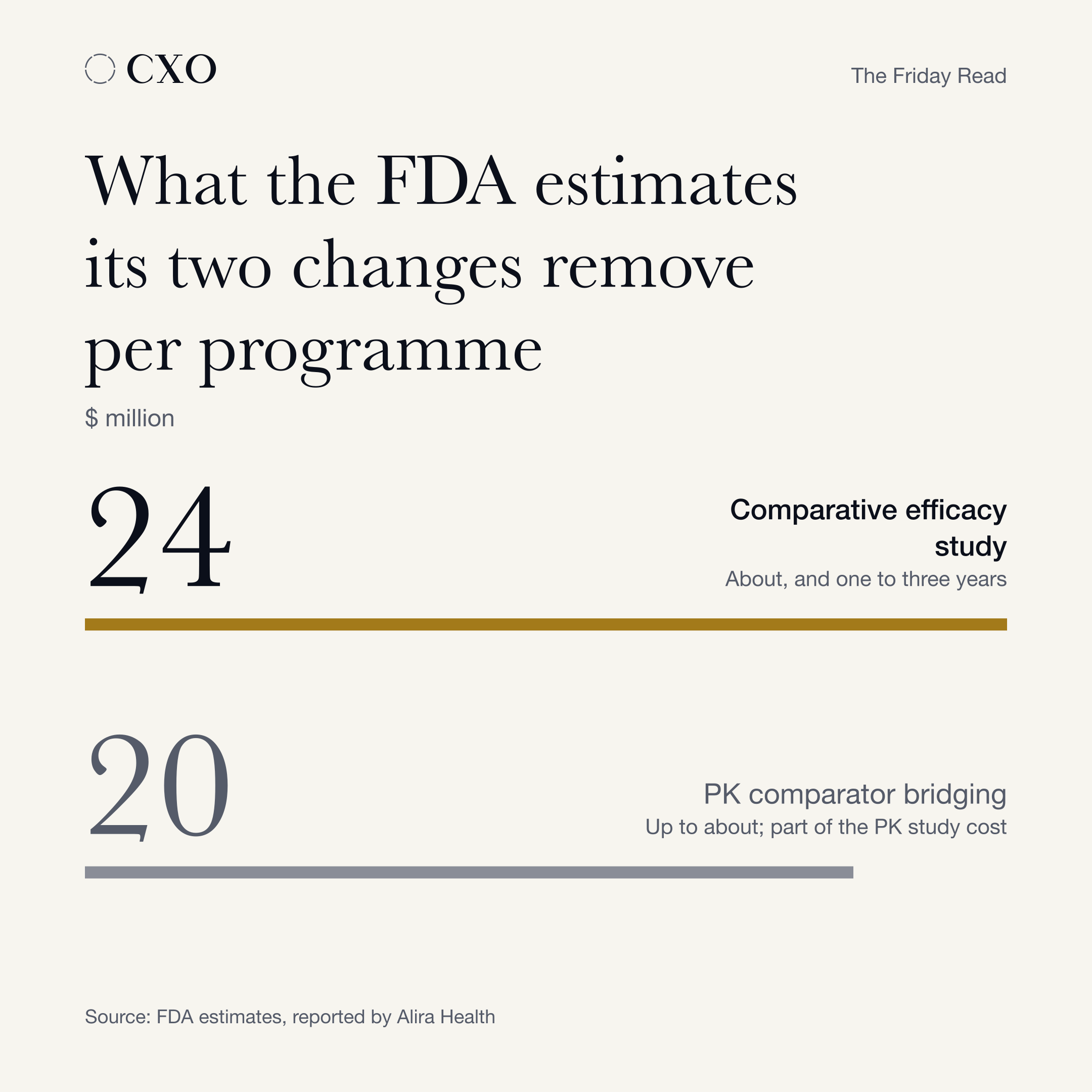
The FDA's text is still a draft. Its guidance of 29 October 2025 proposes that a comparative analytical assessment, a human pharmacokinetic similarity study and an immunogenicity assessment may suffice where products come from clonal cell lines, are highly purified and well characterised, and where a PK study is feasible and clinically relevant. Latham & Watkins notes that locally acting products may still need a comparative study. A second draft on 9 March 2026 allowed wider use of non-US comparators in PK studies. Alira Health reports the FDA's own estimates: a comparative efficacy study costs about $24 million and takes one to three years, and the comparator change saves up to about $20 million per programme by cutting the cost of the PK similarity study. The $20 million is a saving inside that study, so the two figures do not add up to $44 million.
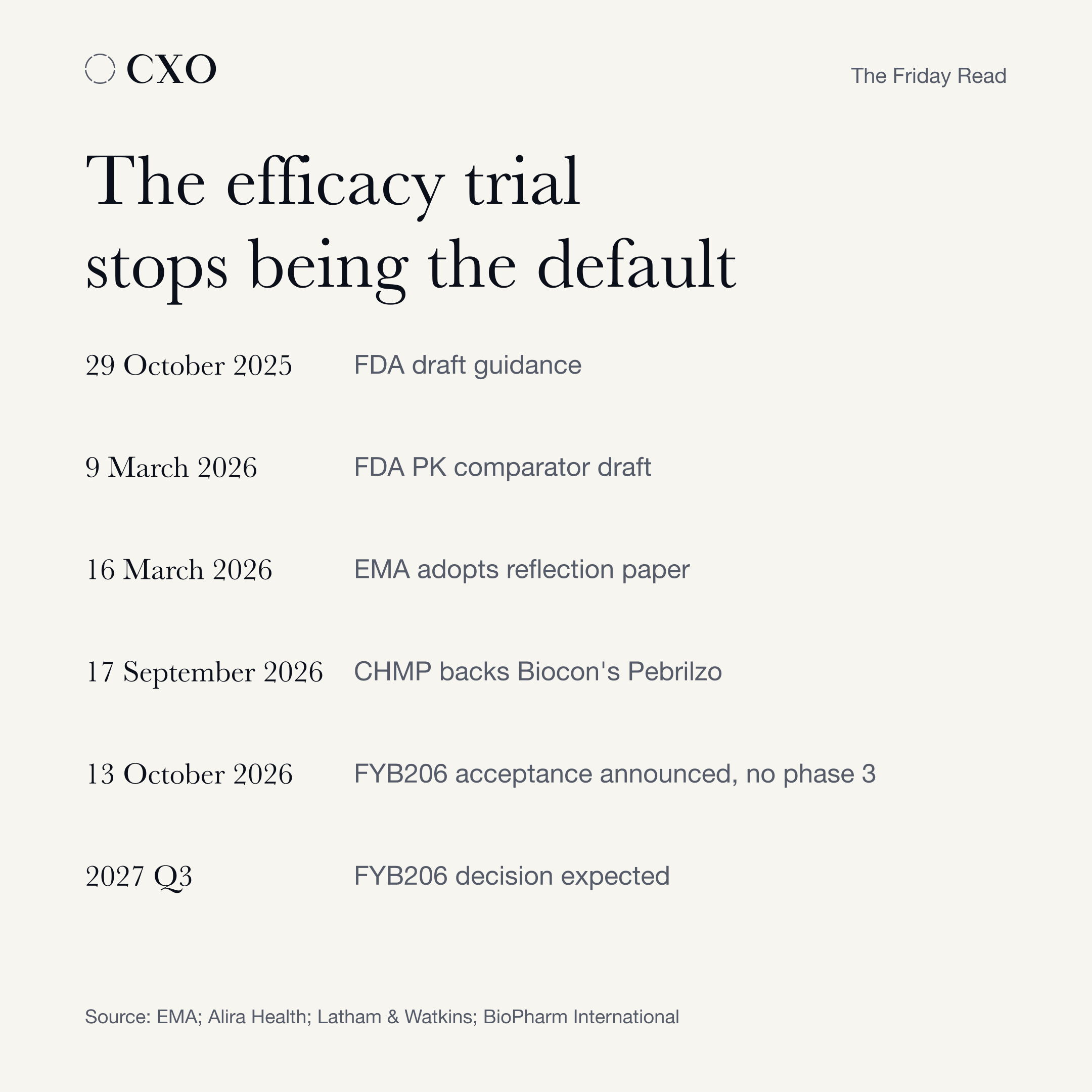
The FDA has already agreed the lighter route with one sponsor. Formycon agreed with the FDA in February 2025 that its pembrolizumab candidate, FYB206, would not need a comparative phase 3 trial, according to BioPharm International. Its main PK study met its primary objective in February 2026, the companies announced the application's acceptance on 13 October and expect a decision in the third quarter of 2027. Formycon puts the saving from skipping phase 3 in the high double-digit millions of euros. At the Association for Accessible Medicines' biosimilars conference on 3 November, Sarah Yim, who directs the FDA's Office of Therapeutic Biologics and Biosimilars, said that "clinical studies are not helping biosimilar programs", RAPS reported on 4 November. The US route is open before the draft is final: sponsors are getting it by agreement, programme by programme.
The Indian position
CDSCO published a draft revision of its Guidelines on Similar Biologics on 6 May 2025. A clinical pharmacologist's review dated September 2026 describes the 2016 guideline as the operative text, and we found no notification since. CDSCO's site could not be reached when we checked on 17 November, so the status rests on secondary sources. A commentary in Perspectives in Clinical Research reads the draft as still generally expecting a comparative efficacy study in India, with waivers only on strong scientific justification, in contrast with the FDA and EMA. An Indian firm can therefore build a lighter dossier for Brussels and Washington than for its home market.
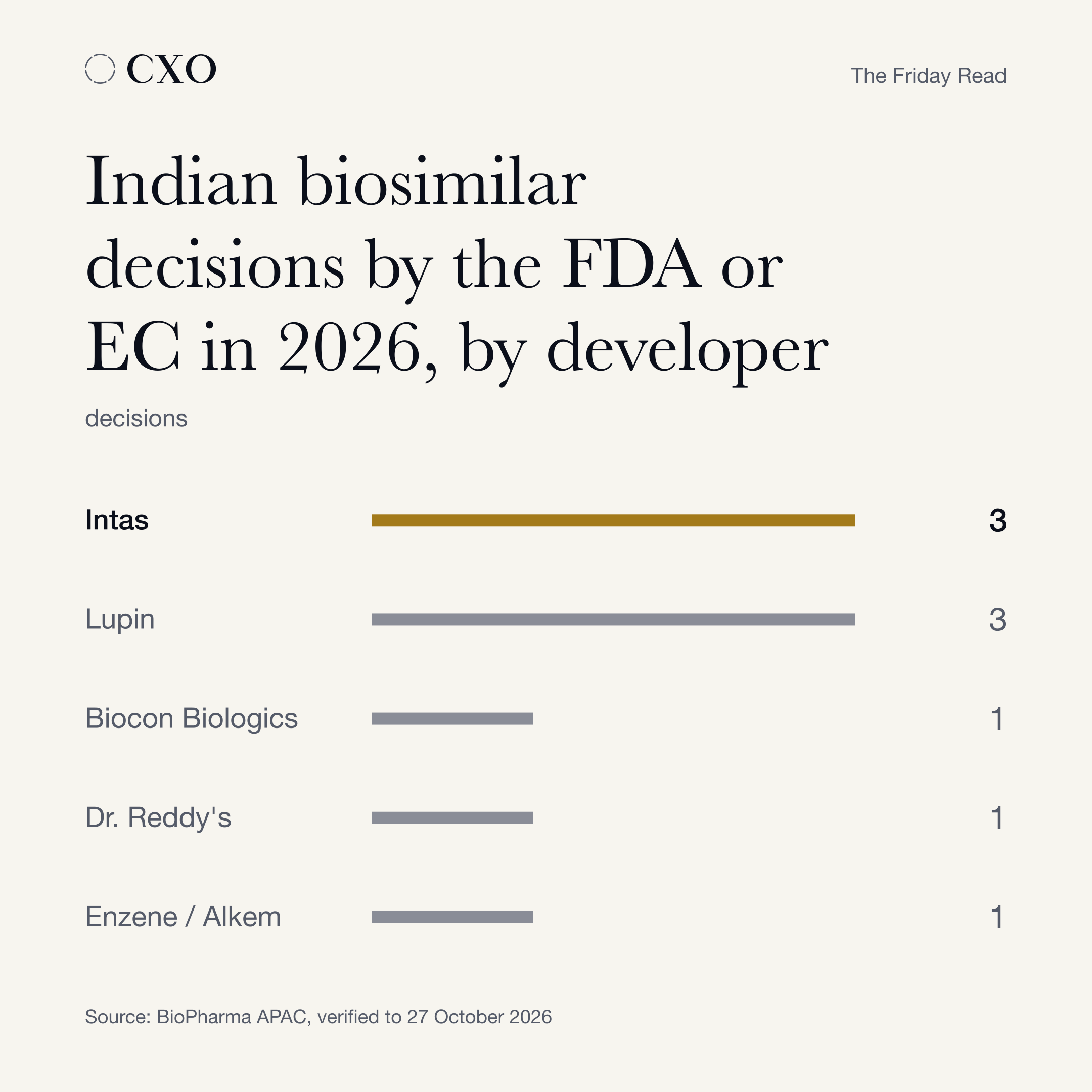
Indian firms took more of this year's US and EU biosimilar decisions than any other Asia-Pacific country. BioPharma APAC counted 17 biosimilar decisions by the FDA or the European Commission in 2026 for products developed or made in the region, verified to 27 October, and nine went to Indian developers across five companies. Intas and Lupin had three each. The molecules are familiar ones, by the article's table: four ranibizumab decisions, two G-CSF products, a denosumab, an etanercept and a rituximab.
The pembrolizumab race shows the cost gap inside one molecule. Formycon and Zydus reached FDA review on PK and analytics. Cipla's partner Qilu Pharmaceutical is running a phase 3 trial of its own pembrolizumab biosimilar, QL2107, BioPharm International reports. Both programmes have Indian commercial partners.
What lower entry cost does to price
The FDA's biosimilar list, on a page current to 28 October, carries 90 entries by our count, nine of them dated 2026, the latest being Lucamzi, a ranibizumab, in October. Samsung Bioepis counted 98 approvals across 21 molecules as of September 2026, of which 75 had launched, so the totals depend on the counting basis. On denosumab, list prices of the biosimilars ranged from 6% to 79% below Prolia, by the company's April 2026 edition of the same report.
Biocon's biosimilars revenue was ₹2,809 crore in the September quarter, up 3%, and segment EBITDA was ₹623 crore, a 22% margin against 25% a year earlier, according to Multibagg's reading of the company's presentation. Biocon linked part of the fall to the timing of revenue recognition on certain shipments, so the quarter does not prove price erosion. Our reading is that once the efficacy trial stops being the main barrier, the number of entrants per molecule rises and returns go to whoever arrives early and makes the product cheaply. That is an inference from the evidence above, and no study we found has measured it.
What carries over and what does not
An Indian developer with strong mass spectrometry, bioassay and PK capability can use one analytical package for both Brussels and Washington. Locally acting products, and products where a PK study tells you little, may still need a comparative study under the FDA draft, and the FDA can ask for one on any programme. Pebrilzo awaits a Commission decision and FYB206 is under review, so neither route has yet produced an approval for an antibody.
We cannot yet prove the commercial half of our case. Two programmes show that the route is open, and nothing we read shows that analytics-first programmes reach market faster on average or earn more once there. We are arguing from the regulators' stated positions and the size of the cost they remove.
What to decide this year
The head of R&D and the chief financial officer should choose the first programme together. Pick the next antibody that meets the FDA's conditions (a clonal cell line, high purity, full analytical characterisation and a feasible PK study) and seek a meeting with the FDA before the clinical plan is fixed, because the Formycon route began with an agreement in February 2025. Move part of that programme's efficacy budget into analytical and PK capacity now, and hold the rest against lower prices at launch, since the denosumab discounts show how wide the price range becomes once several entrants arrive.
Regulatory affairs then has two dossiers to run. File first in Europe and the US where the lighter route is open, and keep an Indian plan on the 2016 guideline with a budget for the comparative study CDSCO may still ask for, until the revision is notified.
Foresight Ledger
By 31 March 2028, the FDA or the European Commission will have approved at least three Indian biosimilars whose dossiers, as stated by the company or the regulator, included no comparative efficacy study. A product counts if an Indian company developed it, or if an Indian company holds the licence to sell it in the market where it is approved. On that rule FYB206, developed by Formycon of Germany and licensed to Zydus for the US, counts if the FDA approves it. That is our judgment, and the evidence above does not prove it. Pebrilzo already has a positive opinion, FYB206 has a decision expected in the third quarter of 2027, Indian developers took nine of 17 regional decisions this year, and the head of the FDA's biosimilar office is telling sponsors that efficacy trials do not help.
We will score it on 30 April 2028. The call is confirmed if three such approvals are on record, and refuted if there are fewer. CDSCO notifying its revised guideline before then would not change the score, though it would weaken our case for separate Indian dossiers.
Tejvir Singh Founder, CXO India cxoindia.com
General information, not investment advice.
This is based on our research into public sources and is not legal advice. Check how it applies to your company with your lawyers and advisers.
Research note. This issue reports on regulatory texts, drafts and public filings as we read them on 17 November 2026. It is general information and is not legal, tax or investment advice. Drafts can change before they are final. Check the source documents and take your own professional advice before acting.
Sources (16)
- EMA reflection paper EMA/CHMP/BMWP/60916/2025: comparative efficacy studies may not be required for well characterised biological substances where the analytical comparability exercise provides a more sensitive determination of biosimilarity, in conjunction with PK and appropriate safety studies. Adopted; first published 27 March 2026; consultation 1 April to 30 September 2025. European Medicines Agency, 2026-03-27.
- CHMP adopted the reflection paper on 16 March 2026. FDA draft guidance 29 October 2025; revised draft Q&A 9 March 2026 on non-US comparators. FDA estimates a comparative efficacy study at about $24 million and one to three years, and the comparator change at up to about $20 million per programme. The $20 million is a cut of up to half in PK similarity study costs, not a saving additional to the $24 million. Alira Health, Biosimilar Regulations: FDA and EMA Changes in 2026, 2026.
- On 17 September 2026 the CHMP adopted a positive opinion recommending marketing authorisation for Pebrilzo (pertuzumab), a biosimilar to Perjeta. EMA, CHMP summary of opinion, Pebrilzo, 2026-09-18.
- Biocon announced on 22 September 2026 that Pebrilzo is the first monoclonal antibody biosimilar to receive a positive CHMP opinion under EMA's tailored clinical approach, based on analytical characterisation and comparative PK data. Goodwin, Big Molecule Watch, 2026-10.
- Biocon Q2 FY27: biosimilars revenue Rs 2,809 crore, up 3%; positive CHMP opinion for pertuzumab, the first mAb biosimilar recommended under EMA's tailored approach; Brazil pertuzumab partnership about $400 million. Biocon, Q2 FY27 results release, 2026-11-04.
- Biocon biosimilars EBITDA Rs 623 crore in Q2 FY27, margin 22% against 25% in Q2 FY26; Biocon said timing of revenue recognition on certain shipments affected growth and margins. Multibagg, Biocon biosimilars margin falls to 22% on shipment timing, 2026-11-05.
- FDA accepted the BLA for FYB206 (pembrolizumab biosimilar), announced 13 October 2026 by Formycon and Zydus; developed without a comparative phase 3 efficacy trial under a path agreed with FDA in February 2025; Dahlia PK study met its primary objective in February 2026; decision expected Q3 2027; saving in the high double-digit million euro range; Cipla's partner Qilu is running a phase 3 trial of QL2107. BioPharm International, 2026-10-13.
- Sarah Yim, director of FDA's Office of Therapeutic Biologics and Biosimilars, at the Association for Accessible Medicines' GRx+Biosims conference (fireside chat on 3 November 2026; RAPS reported it the next day as 'on Tuesday'): 'Clinical studies are not helping biosimilar programs.' Reported by RAPS on 4 November 2026. RAPS, Regulatory Focus, 2026-11-04.
- FDA draft conditions: clonal cell lines, highly purified, well characterised analytically; human PK similarity study feasible and clinically relevant; locally acting products may still need a comparative study. Latham & Watkins, FDA Moves to Streamline Approach to Biosimilars, 2025-11-10.
- FDA biosimilar list page current as of 28 October 2026 shows 90 dated entries by our count, nine dated 2026, latest Lucamzi (ranibizumab-blrz), October 2026. US FDA, Biosimilar Product Information (count by CXO India), 2026-10-28.
- 17 APAC-made biosimilar decisions by FDA or EC in 2026, verified to 27 October: nine Indian from five developers (Intas 3, Lupin 3, Biocon Biologics 1, Dr. Reddy's 1, Enzene/Alkem 1). The table lists four Indian ranibizumab decisions (Ranluspec EU, Ranluspec US, Rexatilux, Vislyfa), two G-CSF (Filkri, Ennumo), one denosumab (Osqay), one etanercept (Fubelv), one rituximab (Zimrixby); the article's prose says three ranibizumab, which does not match its table. BioPharma APAC, 2026-10-28.
- As of March 2026, 92 biosimilars approved in the US across 20 molecules, 67 launched; denosumab WAC discounts 6% to 79% vs Prolia and 6% to 86% vs Xgeva. BioSpace, Samsung Bioepis Q2 2026 US Biosimilar Market Report, 2026-04-27.
- CDSCO published its draft revised Guidelines on Similar Biologics on 6 May 2025; the 2016 guideline is the operative text. Evysaif, Biosimilar Development in 2026 (Dr Idris Dawaiwala), 2026-09-06.
- In contrast to the FDA and EMA, a comparative efficacy study is still generally expected in India under the 2025 draft, with waivers possible under strong scientific justification. Perspectives in Clinical Research (PMC13712628), India's biosimilar reform, 2026-03-12.
- Foresight call and scoring date (30 April 2028) are CXO India's judgment. CXO India, 2026-11-11.
- Samsung Bioepis Q4 2026 edition (fifteenth), released 22 October 2026: as of September 2026, 98 biosimilars across 21 molecules approved in the US, 75 (77%) launched. BioSpace, Samsung Bioepis Releases Fourth Quarter 2026 Biosimilar Market Report, 2026-10-22.