
The RBI's expected credit loss directions and its draft model risk guidance ask for overlapping validation work. We argue banks should fund one independent validation and logging function for credit and AI models, and decide it this budget round.
The Reserve Bank of India issued its expected credit loss directions on 27 April 2026, and they apply from 1 April 2027. On 24 June 2026 it released a draft guidance on model risk that covers every model a regulated entity uses, including AI and machine learning models. Consultation closed on 24 July and the RBI's list of drafts still shows it as a draft. Read together, the two texts ask for overlapping work. We argue that a bank should fund one independent validation and logging function for both credit and AI models, and decide it this budget round, because on our judgment every covered bank will be hiring from the same short supply of validators for the April 2027 date. We also argue that no Indian bank should put an AI value figure in front of its board until that function can stand behind it.
What was done abroad, and what was measured
DBS Group's 2025 annual report says it scaled to over 2,000 models and more than 430 use cases delivering economic value of approximately SGD 1 billion. Forrester's Tom Mouhsian, writing on 22 January 2026, records S$370 million of value by the end of FY2023 and reports that customer outcomes from AI solutions are compared against control groups. DBS adds that a Gen AI coding assistant reduced its data scientists' coding time by up to 20% on certain tasks, and that DBS-GPT now aids two-thirds of its employees. Since July 2025, over 20,000 unique corporate and SME customers have used its Gen AI chatbot, DBS Joy. The bank made a net profit of SGD 11.0 billion with a return on equity of 16.2%, and the value figure should not be read as a slice of that profit.
Two gaps should stop that number travelling straight into an Indian board paper. Forrester says DBS uses control groups but does not describe how they are built, and DBS has published no design we could find. The S$1 billion is also the bank's own figure, grouping revenue, savings and avoided risk, and nothing we read says the S$370 million was counted on the same basis.
An Indian bank can copy the comparison, since someone who did not build the model can check a control group. A value claim with no control group gives that person nothing to check.
Elsewhere the published evidence is thinner. Commonwealth Bank of Australia says customer fraud losses fell by over 20% in the first half of FY2026 compared with the same half a year earlier, and credits its AI-based fraud systems with a crucial role. Fraud losses can be counted, and the bank's release gives no comparison group. At Citigroup, Jane Fraser told analysts on 13 October 2026 that the bank is typically seeing a 30% to 40% increase in the speed of product launches and has cut tech vendor spend by 30% year-over-year as 14,000 engineers use its main agentic coding tool. Those are management statements on an earnings call.
JPMorgan's finance chief has argued against the exercise altogether. Jamie Dimon had given $2 billion as the bank's annual AI investment. On the bank's third-quarter call in October 2026, as The Stack reported it, chief financial officer Jeremy Barnum called that figure "not exactly right", put actual spend nearer $700 million, and said of measuring returns, "I am just very reluctant to spend a lot of energy quantifying it", because it "winds up wasting a lot of people's time inside the institution". That stance is coherent for a bank that declines to publish a return. An Indian bank that puts a crore figure in a release has already given it up, and several have.
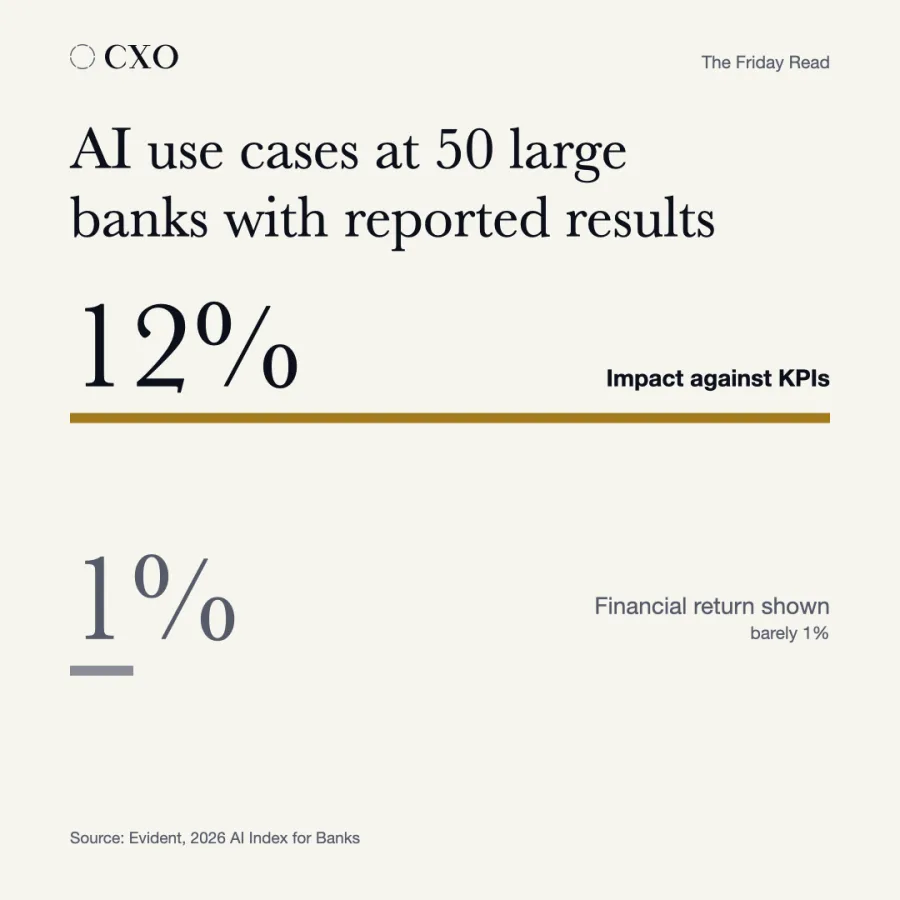
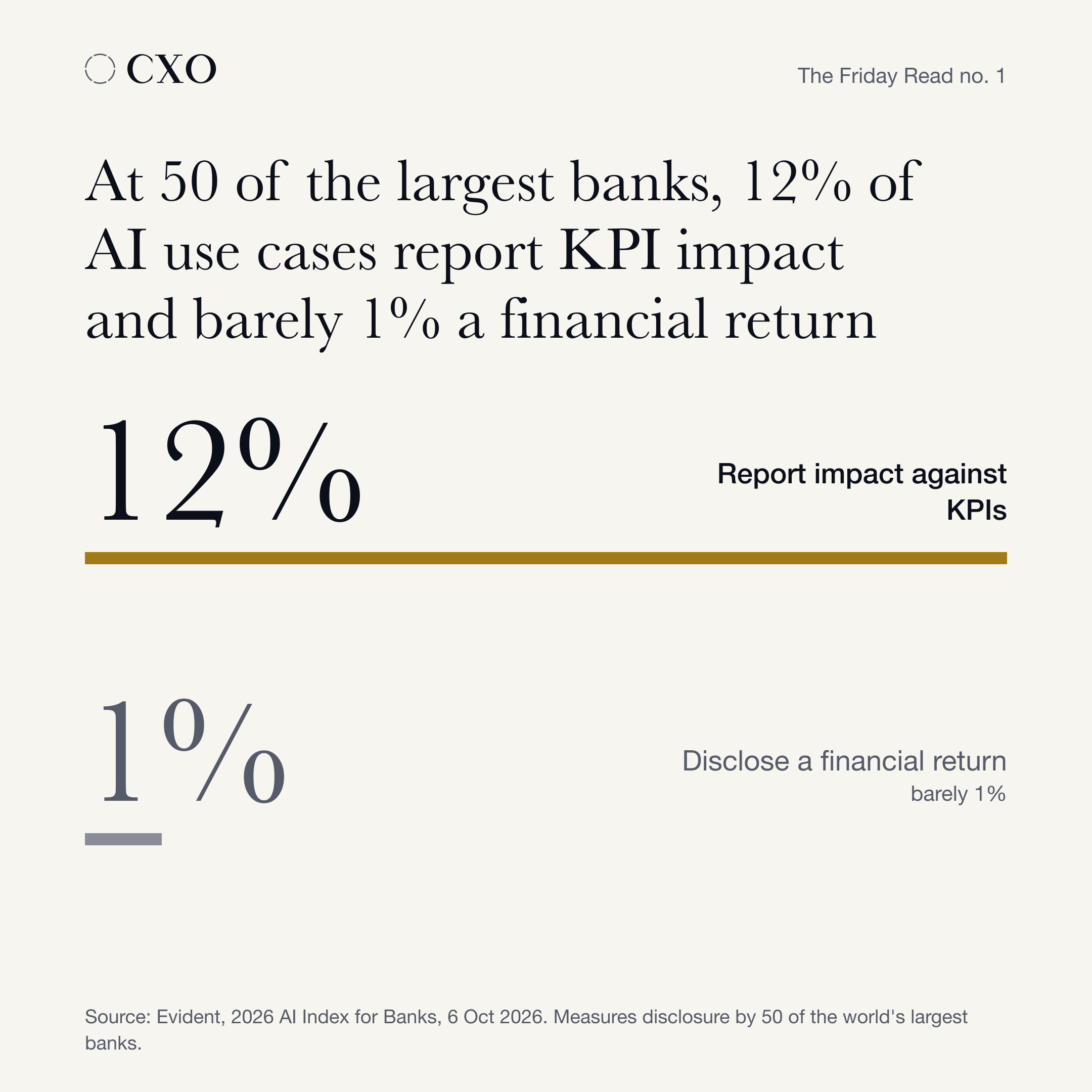
Evident's 2026 index of 50 of the world's largest banks, which ranks JPMorganChase first, found that 12% of AI use cases report impact against operational KPIs and that barely 1% disclose concrete financial returns. The index measures disclosure, so some of these banks may be counting privately. Between that and the silence on DBS's design, an Indian bank that wants a number it can defend in public should expect to build the method itself.
The Indian position
The best baseline is the RBI's own FREE-AI committee survey. It ran from February to May 2025 and covered 612 supervised entities, of which 20.8% were using or developing AI, which is the 127 entities in the follow-up figures. We have now read these figures in the committee's report itself. They describe a group of firms more than a year ago, and large private banks may sit well ahead of them.
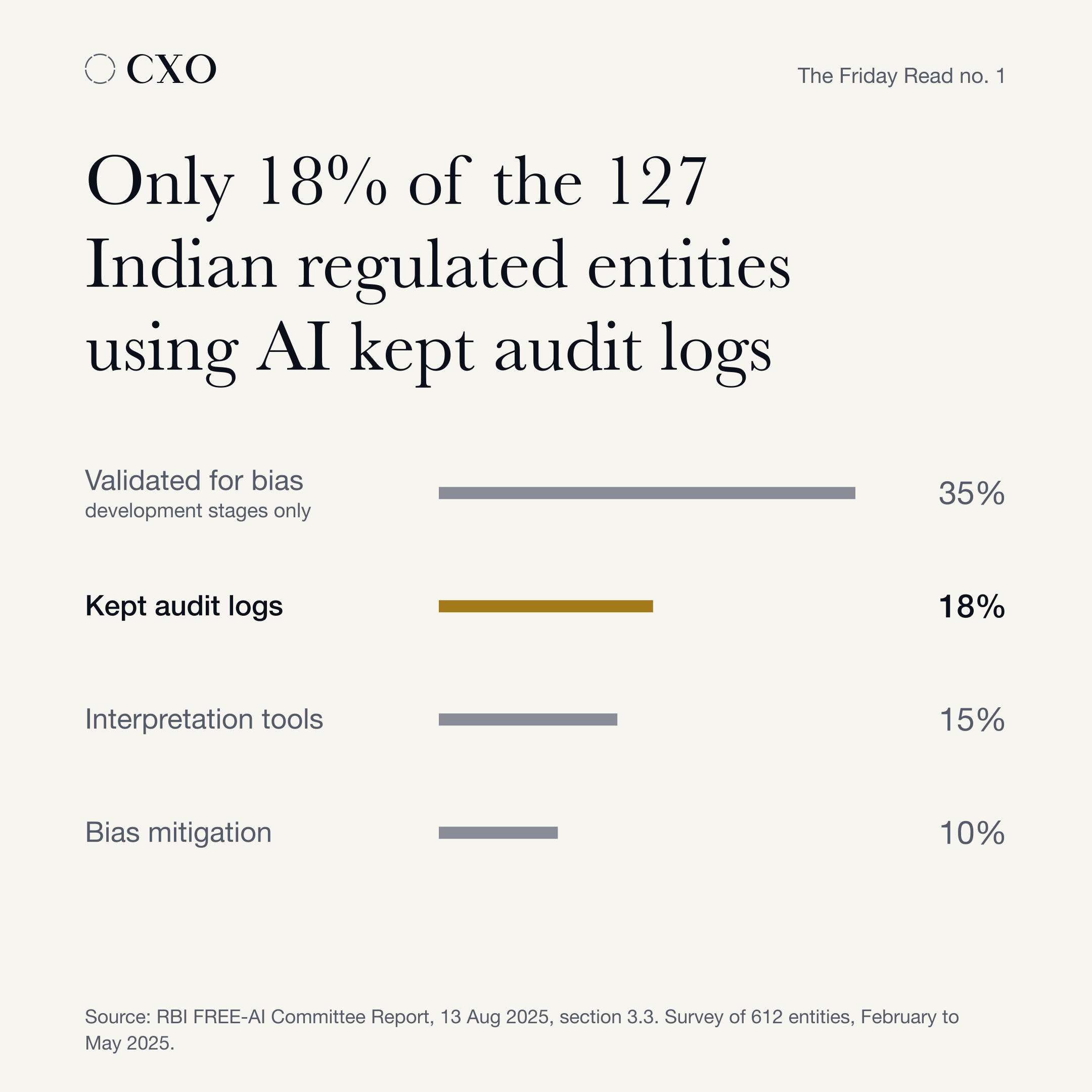
Only 18% of those 127 kept audit logs, and logs are what a validator starts from. The report adds that only one-third of respondents, mostly large public and private sector banks, had some board-level framework for AI oversight.
Banks now report results, and nothing we read shows how any of them was measured. In figures shared with The Economic Times and reported by BFSI Network on 2 November 2026, HDFC Bank said service-delivery turnaround times were cut by 30% in the September quarter, Kotak Mahindra Bank said the same team can handle 20% to 30% more volume, and AU Small Finance Bank said the cost of its AI-led voice operations halved. SBI's chairman linked about ₹22,000 crore of business in the June 2026 quarter to AI-generated analytical leads, and Bajaj Finserv's investor presentation of 3 November credits its AI programme with over ₹6,500 crore of loan disbursements in the first half of FY27. We found no baseline or control group behind any of these, and no independent check. A lead that converts might well have converted anyway, and only a control group separates the two cases.
Inputs are easier to find. Sashidhar Jagdishan, HDFC Bank's chief executive until 26 October, counted 5 AI use cases in production and 14 in development on the FY26 earnings call (Anup Bagchi has led the bank since 27 October), and ICICI Bank's Group CFO put technology at about 11% of operating expenses in FY26 and about 11.4% in the first quarter of FY27. The ICICI number covers all technology, and neither bank attaches a measured return to these figures.
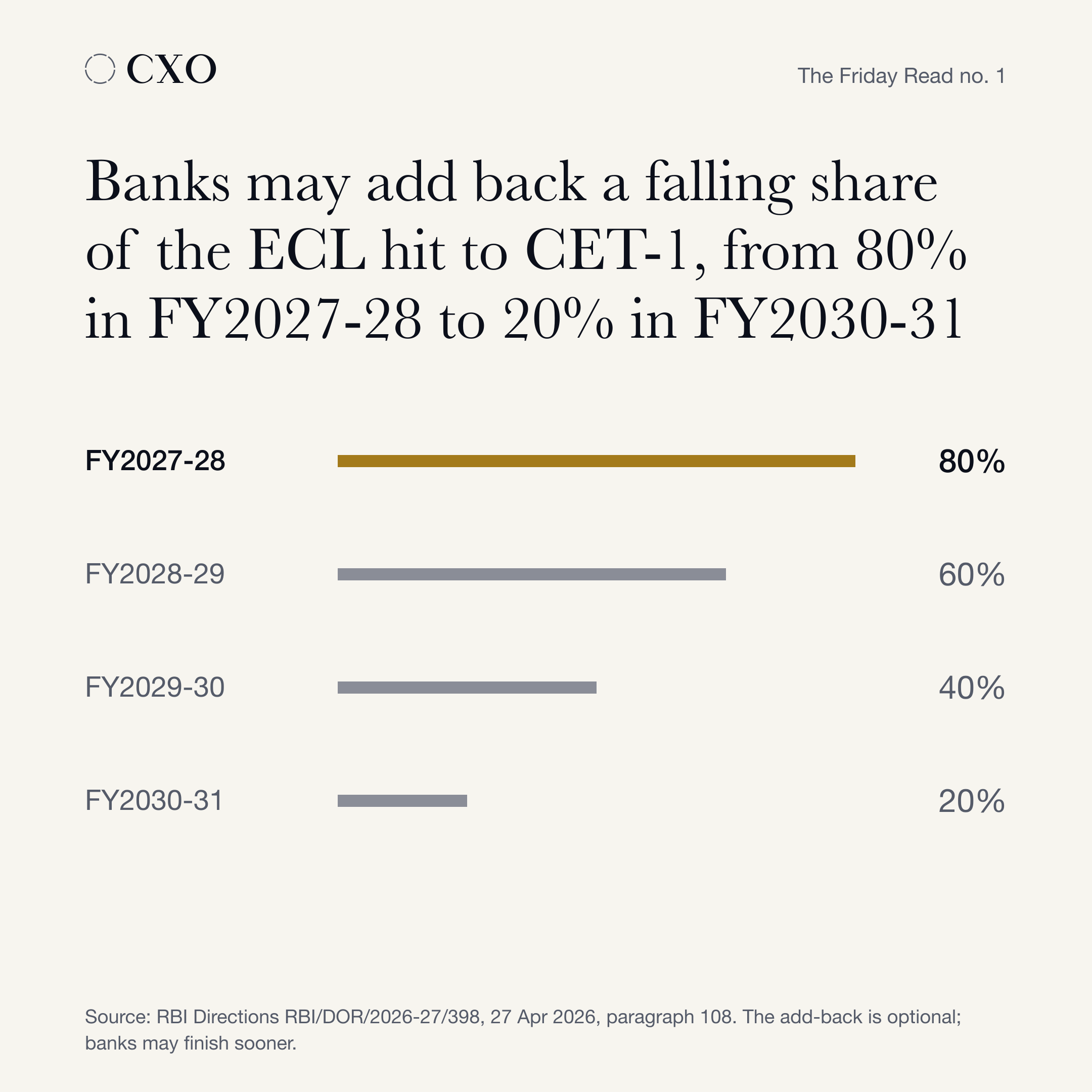
The competing claim on board time is capital. CRISIL Ratings estimated on 30 April that the move would cut CET-1 by up to 120 basis points net for most banks, and by up to 170 basis points gross. SBI's chairman put the bank's hit at ₹19,500 crore net of tax on 3 November. Bank of Baroda's chief executive put the provisions it needs for the transition at about ₹12,500 crore, without saying whether that figure is before or after tax. The RBI was to meet bankers on 12 November to review readiness, and banks were reported to be seeking revised provisioning rates and a phased start. We found no public account of the outcome by 14 November. The RBI lets banks add back a declining share of the adjustment to CET-1 through 2030-31, at their option.
Some summaries in circulation have the directions wrong, so we read the final text. It sets no minimum number of years of historical data, requiring instead an adequately representative period (paragraph 64). It requires multiple macroeconomic scenarios without fixing a number (paragraph 48). Post-implementation back-testing is mandatory (paragraph 131), and we found no fixed annual frequency in the text. KPMG notes that the five-year minimum appeared in the draft and was dropped. A budget built on the summaries will be wrong on data and on scenario cost.
What the text does require is the control layer our argument rests on. Paragraph 57 asks a board-level committee including the CFO and CRO to ensure complete independence of the internal model validation function. Paragraph 74 requires a three-tier model risk framework across front-line operations, risk and internal audit. Paragraph 120 requires a model inventory.
The June draft applies the same thinking to AI. It defines models to include AI and machine learning techniques, requires independent validation of third-party models even where the vendor offers its own certification, and requires an inventory naming owners, developers, validators and approvers. It also asks for kill-switch arrangements and for explainability thresholds set model by model. The RBI followed it with a draft on data governance on 15 July 2026. We expect these texts to converge into one regime, and a bank that builds two functions may end up merging them, though the draft could still change before it is final.
Validation is where the two texts sit closest. The directions ask for independent validation before a model goes live, and the draft asks for validation before and after deployment and after any change. Both want a model inventory and a committee of the board in the loop. The draft goes further on AI and asks for controls against hallucinations and for red-teaming, which are tests a credit modeller has never run. Paragraph 111 makes the provisioning itself compulsory from FY2027-28, whether or not a bank uses the transitional add-back, so nobody can defer the validation work by deferring the capital hit.
What carries over and what does not
A holdout group needs no new regulation, and an Indian retail book should be large enough to give clean samples on a single product. Comparing a treated group against an untreated one is cheap next to the cost of a wrong number in an annual report.
Lending makes it dearer than servicing. Withholding an AI collection script or a pre-approved offer from a control group costs real revenue, and the draft guidance asks banks for bias and fairness assessments. Start where the control is cheap and the outcome easy to count, such as fraud alerts or back-office document reading.
Indian banks also begin from further back. DBS describes itself as holding a strong digital and data moat, and Indian banks will meet their data gaps during Day 1 work. A gap found while assembling loss history for an expected credit loss model is one the AI programme should record once and fix once.
Our own argument has limits. DBS is a single bank describing itself in a market with a different regulator, and nothing we read proves that banks with stronger validation earn more from AI. The case here rests on the overlap in the controls and the cost of building them twice.
One function does not mean one skill set, and this is where the overlap argument can be oversold. A validator who can test a probability-of-default model has no training in red-teaming a generative model. We would build one function with one standard and one head, and inside it two specialist benches that share the inventory and the logs. The saving comes from the shared plumbing and from having one person accountable to the board, and a bank should plan its hiring on the assumption that validators specialise.
We expect independent validators to be the scarce resource. Every covered bank needs them for the same April 2027 date, and the draft's requirement to validate third-party models adds to the demand.
What each executive should decide this year
Begin with a count in the chief information officer's office. List every model in the expected credit loss scope and every AI model in production, and mark who could validate each today and whether its decisions are logged. The logging standard follows from that list, with one model inventory covering credit and AI models, the fields the draft names and a change log of versions and approvals. The draft would keep decommissioned models on the inventory for at least ten years, so retention has to be designed in at the start. A CIO who cannot produce the list quickly has learnt where the programme stands.
For the chief financial officer, the decision is what counts as a number. We would let no AI value figure into a budget or an investor deck unless it rests on a comparison group and has been reviewed by someone outside the team that built the model. Validators belong in the expected credit loss programme as a cost, with a stated share charged to AI. The transitional add-back also needs settling now, whether taken in full or with the transition completed sooner, since paragraph 108 allows either.
Structure falls to the chief risk officer. We favour one independent validation function with one named head, reporting so that it stays independent of the people who build models. Separate teams need a sound reason and, at the least, one logging standard. The draft would send validation reports to the risk committee of the board, or an authority it delegates to, within three months of completion, and that cycle sets the size of the team. The first test we would run is one AI use case in a retail book, with a control group under it, held to the standard applied to a probability-of-default model.
Foresight Ledger
This is our judgment, and the evidence above does not prove it.
Our call is that at least two of India's five largest private banks will publish an AI value figure tied to a stated control-group method. Public sector banks will take longer, because the capital effect of the new provisioning absorbs their attention first.
We will score it on 30 September 2028, against the FY2027-28 annual reports. The call is confirmed if two of those banks state an AI value number with a named comparison method, and refuted if fewer than two do. An RBI request for AI model inventories will not count as a signal, because the June draft already asks for one.
Research note. This issue reports on regulatory texts, drafts and public filings as we read them on 14 November 2026. It is general information and is not legal, tax or investment advice. Drafts can change before they are final. Check the source documents and take your own professional advice before acting.
Sources (28)
- RBI (Commercial Banks) Asset Classification, Provisioning and Income Recognition Directions, 2026, issued 27 April 2026, effective 1 April 2027. RBI press release 2026-2027/150, 2026-04-27.
- Directions text: paragraph 57(5) complete independence of internal model validation function, board committee including CFO and CRO; paragraph 64 sufficient historical loss data over an adequately representative period with no minimum years; paragraph 48 multiple scenarios with no stated number; paragraph 74 three-tier model risk management framework; paragraph 120 model inventory framework; paragraph 131 post-implementation back-testing with no fixed frequency; paragraph 108 optional CET1 add-back of 4/5 (80%) for FY2027-28, 3/5 (60%) for 2028-29, 2/5 (40%) for 2029-30, 1/5 (20%) for 2030-31, transition period ending 31 March 2031 and banks may complete it sooner. RBI Directions RBI/DOR/2026-27/398, 2026-04-27.
- Draft Guidance on Regulatory Principles for Model Risk Management issued 24 June 2026; comments due 24 July 2026; covers all models including AI and ML. RBI press release 2026-2027/528, 2026-06-24.
- Draft text: AI/ML included in definition of model; independent validation of all models including third-party models regardless of provider certification; inventory with owners, developers, validators and approvers; decommissioned models kept on inventory at least ten years; validation reports to the RMCB, or an authority it delegates to, within three months of completion (paragraph 33). RBI draft guidance, 2026-06.
- Draft listed as draft; draft guidance on regulatory expectations for data governance dated 15 July 2026. RBI Draft Notifications/Guidelines page, re-checked 2026-11-14: model risk guidance and data governance guidance both still listed as drafts.
- Draft requires kill-switch arrangements, explainability thresholds model by model, and fairness assessments. MediaNama, RBI Draft Rules Push Kill Switches, 2026-06-25.
- KPMG: the draft guidelines prescribed at least five years of historical data; the final directions give flexibility based on portfolio type and vintage. KPMG in India, Expected Credit Loss, May 2026, 2026-05.
- In 2025 DBS scaled to over 2,000 models and more than 430 use cases delivering economic value of approximately SGD 1 billion (S$1 billion); DBS-GPT aids two-thirds of employees; Gen AI coding assistant reduced coding time by up to 20% on certain tasks; net profit SGD 11.0 billion; ROE 16.2%. DBS Group, Annual Report 2025, Letter from Chairman and CEO, published 2026 (FY2025 figures).
- Tom Mouhsian, Forrester, 22 January 2026: S$370 million value by end FY2023; S$1 billion in 2025; customer outcomes compared against control groups; value grouped as revenue, cost savings and risk avoidance; article does not describe how groups are built. Forrester, DBS Bank's Billion-Dollar AI Dream, Realized, 2026-01-22.
- Commonwealth Bank: customer fraud losses fell by over 20% in the first half of FY2026 versus first half of FY2025. CommBank newsroom, 2026-02-05.
- Citigroup Q3 2026 call, 13 October 2026, Jane Fraser: 30% to 40% increase in speed of product launches; 14,000 engineers use agentic coding tool; tech vendor spend reduced by 30% year-over-year. Citigroup Third Quarter 2026 Earnings Call transcript, 2026-10-13.
- Jeremy Barnum: $2 billion figure not exactly right, annual AI spend about $700 million; quotes as given. JPMorgan's own transcript was not opened; the quotes rest on The Stack and other secondary reports. The Stack, JPMorgan: Quantifying AI benefits is wasting time, 2026-10-14.
- Evident 2026 AI Index: 50 of the world's largest banks; 12% of use cases report impact against operational KPIs; barely 1% disclose concrete financial returns. Evident, 2026 AI Index for Banks, 2026-10-06.
- RBI FREE-AI survey of 612 supervised entities ran February to May 2025; 20.80% (127) were using or developing AI. RBI, Report of the Committee on the Framework for Responsible and Ethical Enablement of AI (FREE-AI), section 3.3, 2025-08-13.
- Of the 127 entities using AI: only 15% used interpretation tools, 18% maintained audit logs, 35% validated for bias and fairness (limited to development stages), 10% had bias mitigation; only one-third of respondents, mainly large public and private sector banks, reported some board-level framework for AI oversight (paragraphs 3.3.11 to 3.3.13). RBI, FREE-AI Committee Report, 2025-08-13.
- HDFC Bank turnaround times cut 30% in the September quarter; Kotak same team handles 20% to 30% more volume; AU SFB voice operation cost halved; figures shared with The Economic Times; reported 2 November 2026. BFSI Elets, Indian Banks Report Up to 50% Gains From AI, 2026-11-02.
- SBI chairman linked about ₹22,000 crore of business to AI-generated analytical leads in Q1 FY27 (April to June 2026), at the results interaction of 7 August 2026. Financial Express B2B, 2026-08-18.
- Bajaj Finserv Q2 FY2027 investor presentation, slide 21: realised impact for H1 FY2027, loan disbursements 6,500+ crore. Bajaj Finserv, BSE filing, 2026-11-03.
- CRISIL Ratings: ECL transition to cut CET-1 by up to 120 basis points net (up to 170 basis points gross) for most banks. The Week (PTI), ECL transition to impact banks' core equity buffers by 1.20 pc: Crisil, 2026-04-30.
- SBI chairman C S Setty, 3 November 2026: 'The ECL impact net of taxes will be 19,500 crores'. Moneycontrol via TradingView, SBI puts ECL models in place, estimates Rs 19,500-crore post-tax impact, 2026-11-03.
- HDFC Bank: 5 AI use cases in production and 14 in development on the FY26 earnings call (Sashidhar Jagdishan, then MD and CEO); ICICI Bank technology about 11% of operating expenses in FY26 and about 11.4% in Q1 FY27. Financial Express B2B, 2026-08-18.
- RBI Directions paragraph 111: banks must calculate and maintain ECL provisions from FY2027-28 irrespective of the transitional arrangement. RBI Directions RBI/DOR/2026-27/398, 2026-04-27.
- DBS: since July 2025 over 20,000 unique corporate and SME customers have used DBS Joy; Evident ranks JPMorganChase first. DBS Annual Report 2025 letter; Evident 2026 AI Index, 2026-10-06.
- Draft requires controls against hallucinations and red-teaming. MediaNama, 2026-06-25.
- Foresight scoring date of 30 September 2028 is CXO India's judgment, set for the FY2027-28 annual reports; 2030-31 is the last add-back year. CXO India judgment (Foresight Ledger); RBI Directions paragraph 108, 2026-11-10.
- Bank of Baroda MD and CEO Debadatta Chand: about ₹12,500 crore needed for the ECL transition (gross or net of tax not stated). PSU Watch, Bank of Baroda Q2 profit up 31%, 2026-10-30.
- RBI to meet bankers on 12 November on ECL provisioning; banks seek revised provisioning rates and phased implementation. No report of the outcome found by 14 November 2026. Free Press Journal, 2026-11-06.
- Anup Bagchi MD and CEO of HDFC Bank from 27 October 2026, after Sashidhar Jagdishan's term. Business Standard, HDFC Bank board appoints Anup Bagchi as MD and CEO, 2026-10-01.