The decision this week
Indian exporters and their US buyers are setting FY28 prices now. We would price on the 10% Section 301 duty staying in place for the life of the contract, and write in three clauses for the ways it could move. Since 24 July most Indian goods have paid 10% on top of the normal US duty, under the forced-labour action the US Trade Representative announced on 23 July. Exports to the US still rose 14.5% to $59.52 billion in April to October, from $51.99 billion a year earlier, on Commerce Ministry figures released on 13 November, as reported by Maritime Gateway. The total has held up so far, which leaves both sides room to settle now who carries the next change.
A trade deal has no date. USTR's notice set India's rate on findings that include India's adoption of a forced-labour import prohibition, and Holland & Knight reads the 10% as removable only once USTR finds that a country effectively enforces that prohibition. India's ban came by a DGFT gazette notification of 13 July, which inserted paragraph 2.20B into the Foreign Trade Policy, and experts quoted by Outlook India called it a legal framework more than an operating ban. Commerce Secretary Rajesh Agrawal said on 15 October that the deal "has to be signed when the overall tariff structure is getting formalised", and linked that to "some of the outcomes of the 301". On 10 November an Indian official told Reuters that talks on a first tranche continue and that US officials visited this month to discuss customs and trade facilitation. On 15 November Commerce Minister Piyush Goyal said Indian goods will get preferential access to the US at lower duties than competitors, and that both sides aim to conclude the first tranche by the end of this financial year, All India Radio reported. Nobody has given a signing date or a rate.
A court ruling could come sooner, and its reach is uncertain. Importers sued at the US Court of International Trade on the day the duty began. A three-judge panel heard argument on 30 September and on 2 October asked for further briefs on USTR's authority, standing and remedy. In an order issued late on 4 November, reported by Inside US Trade and ABS News Service, the panel told plaintiffs to declare by 10 November the economies they import from, after judges raised at the hearing the possibility of relief only for the countries those firms trade with. We found no ruling as of 17 November. A ruling against USTR could therefore cover some importers and some countries and leave the rest paying, and it could open refund claims on entries already made. USTR refused an exclusion process in July and pointed instead to the review provision in Section 307 of the Trade Act.
A separate Section 301 case, on structural excess capacity, could add duty on top. It names India among 16 economies and covers 21 sectors. EcoVadis found no findings or proposed action as of 17 October, our search on 17 November found none, and the statutory deadline for a determination is 11 March 2027. Holland & Knight expects any resulting tariff to stack on the forced-labour duty, and the Congressional Research Service notes that a 2025 Federal Circuit ruling gives USTR room to modify Section 301 actions once taken. If nothing else happens, CRS also notes that Section 301 actions end automatically after four years unless a domestic industry asks for continuation, which by our arithmetic puts the first such point in July 2030.
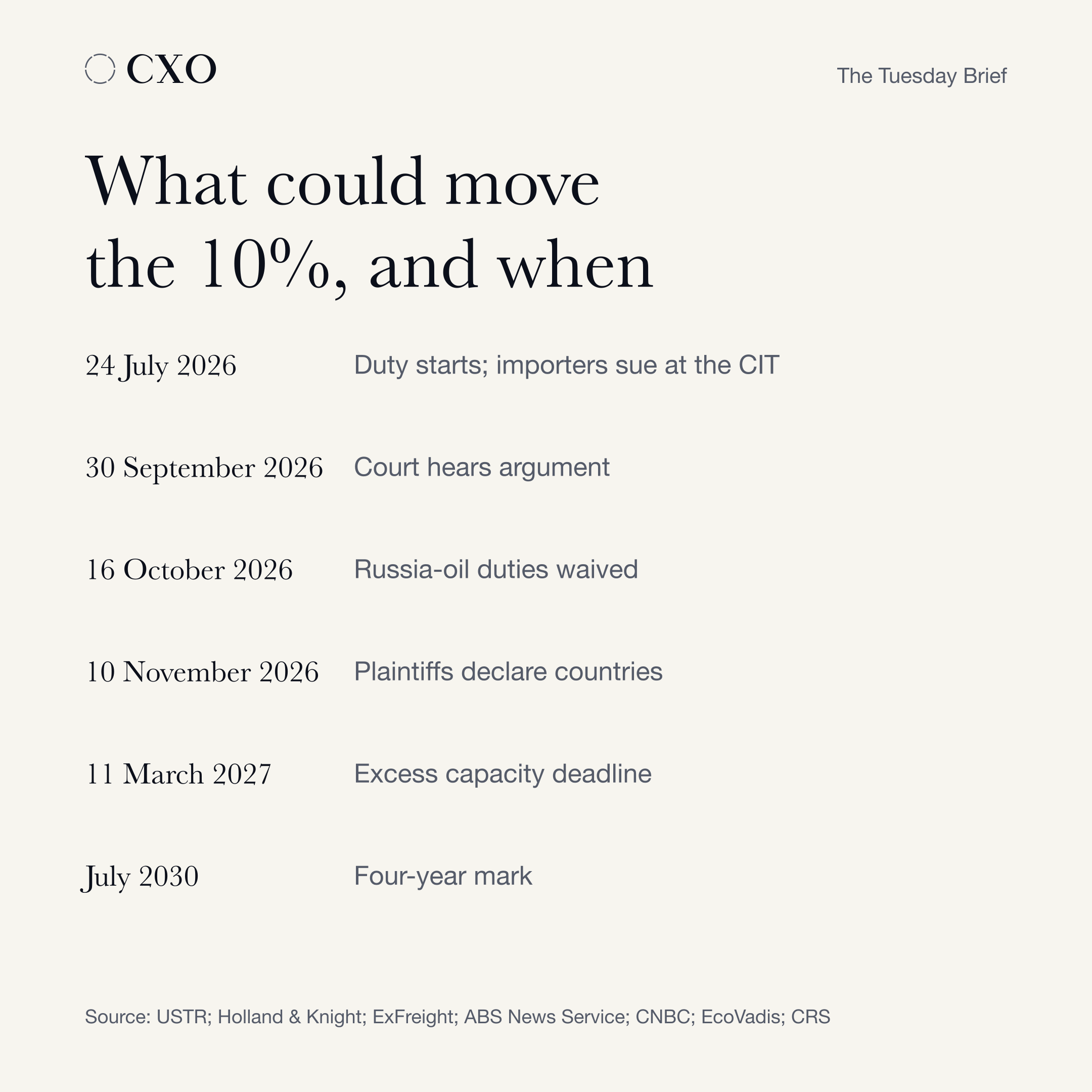
We would write three clauses. The first deals with the 10% falling away, by deal or by court, and names who files for any refund and how the money passes to the party that bore the duty. Only the US importer of record has clear standing to seek a refund, Troutman Pepper noted on 12 October, and relief won by other plaintiffs may not reach a firm outside the case, so the clause should oblige the importer to keep its own claim alive, by joining the suit or filing its own. An Indian exporter selling FOB cannot claim anything itself. The second reopens price if a new Section 301 duty on excess capacity applies to the product, with a review date after 11 March 2027. The third covers the Russian-oil sanctions law. Trump's order of 16 October waived its duties of up to 100% on the largest buyers of Russian oil, a group CNBC reported includes India, and the order sets no end date, so it can be withdrawn at any time.
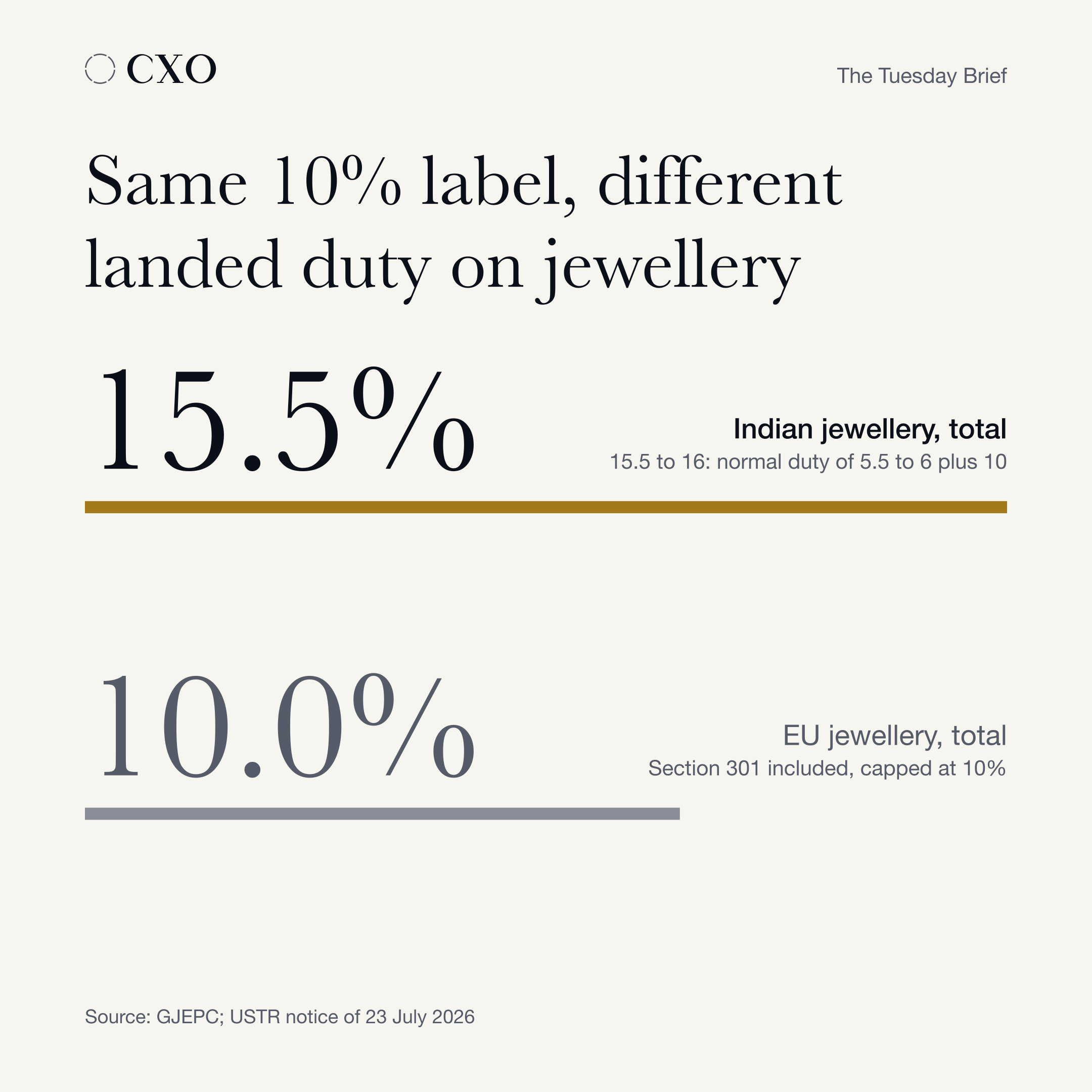
Before quoting a price, look up the product's HTS line in Annexes I and II of USTR's notice, which list the exclusions, and in the Section 232 lists. Goods under Section 232 pay that rate instead, with auto parts at 25%, and India's Commerce Ministry estimated on 25 July that 45% of exports to the US fall outside the new duty, as PTI reported. On a line that does pay, the normal duty decides how hard the 10% lands. Indian jewellery pays about 15.5% to 16% in total, the 5.5% to 6% normal duty plus 10%, according to GJEPC, while EU jewellery, with a similar normal duty, pays 10% in total under USTR's cap.
Three things in this evidence are weak. The 14.5% export rise compares with seven months that included the 50% duty period from 27 August 2025, so it flatters the current position and says nothing about individual sectors. The 4 November court order is known only from trade press reports, and the court has given no date for its ruling. The excess capacity case has published nothing on India specifically.
Abroad
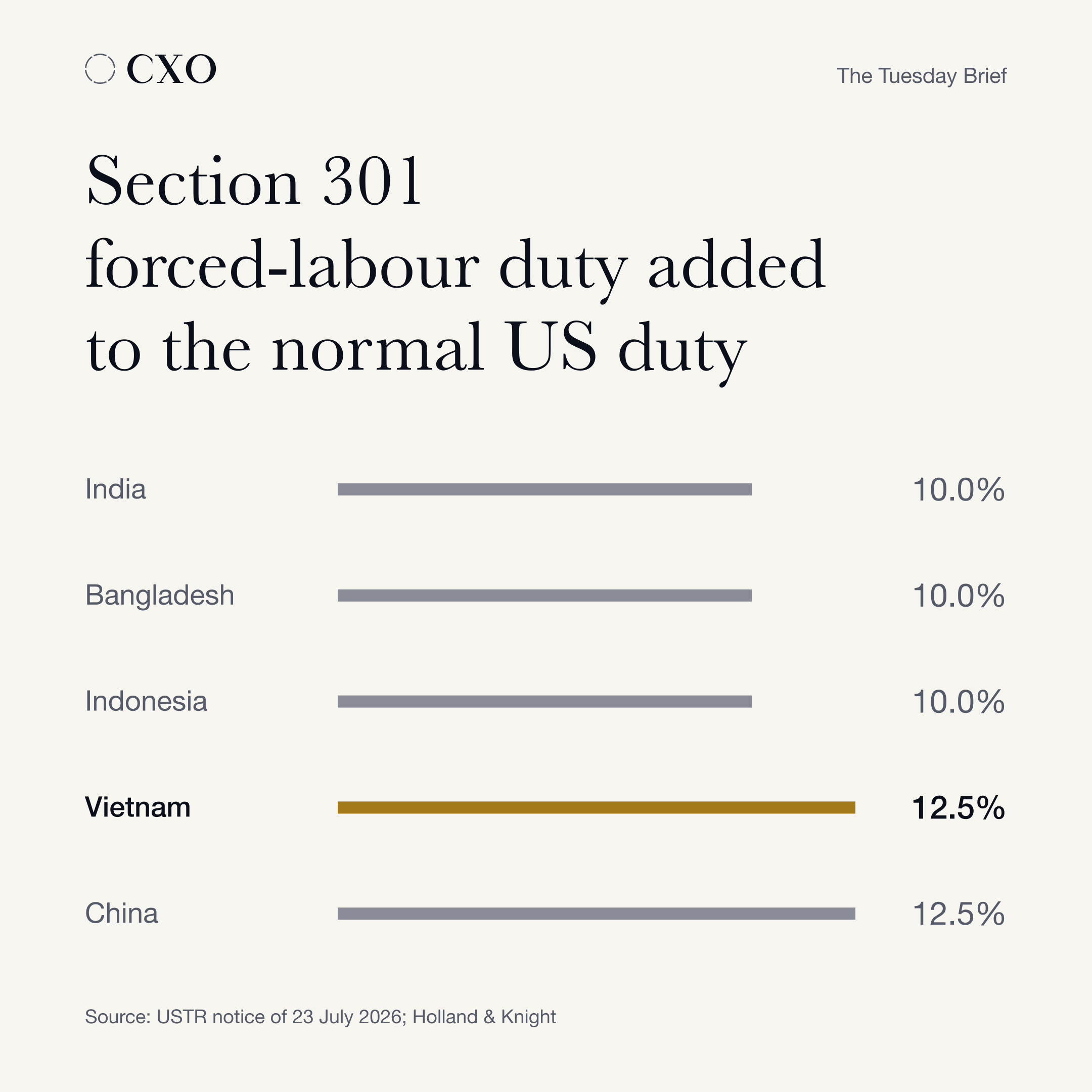
USTR set a total-duty cap for the EU, Taiwan, Japan, Korea and Switzerland, and an added duty for everyone else. Products of the EU and Taiwan pay a combined 10% including their normal duty, and products of Japan, Korea and Switzerland a combined 12.5%, with no Section 301 duty where the normal rate already reaches the cap. India, Bangladesh, Indonesia, Malaysia and Cambodia pay 10% on top of their normal duty, and China and Vietnam pay 12.5% on top.
In apparel, Bangladesh may gain a quota that India does not have. The notice directs USTR to set textile tariff-rate quotas for Bangladesh, Cambodia, Indonesia and Malaysia, a set volume at a lower rate tied to their use of US textile inputs, as soon as feasible; Holland & Knight reads that as no earlier than 1 September. India is not named. Strix found no Federal Register notice establishing the quotas as of 27 October, and our search on 17 November found none. If they start, an Indian apparel exporter competing with Bangladesh will face a gap that the headline 10% does not show.
By the numbers
$18.48 billion was India's goods surplus with the US in April to September, against $20.07 billion a year earlier. Source, Commerce Ministry via ANI.
26% was the rise in imports from the US over the same period, to $32.33 billion. Source, Commerce Ministry via ANI.
471 more products were excluded from the forced-labour duty in USTR's final notice. Source, USTR notice of 23 July.
60 economies are covered by the forced-labour action. Source, USTR notice of 23 July.
Tejvir Singh Founder, CXO India cxoindia.com
This is based on our research into public sources and is not legal advice. Check how it applies to your company with your lawyers and advisers.
Research note. This issue reports on regulatory texts, drafts and public filings as we read them on 17 November 2026. It is general information and is not legal, tax or investment advice. Drafts can change before they are final. Check the source documents and take your own professional advice before acting.
Sources (24)
- USTR imposed 10% tariffs on products of India based on findings including India's adoption of a forced labour import prohibition after the 5 June 2026 notice, except products in Annex I and Annex II Part A. USTR, Notice of Action in the forced labour Section 301 investigations, India determination, 2026-07-23.
- The 10% group is Argentina, Bangladesh, Cambodia, Canada, Ecuador, El Salvador, Guatemala, Honduras, India, Indonesia, Jordan, Malaysia, Mexico, Pakistan, Sri Lanka, the UK and Trinidad and Tobago. EU and Taiwan products are capped at a combined 10% net of MFN and Japan, Korea and Switzerland at 12.5%, with zero Section 301 duty where MFN meets the cap. All other investigated economies pay 12.5%. USTR, Notice of Action (Presidential memorandum, Sec. 1), 2026-07-23.
- USTR declined to create an exclusion process and said Section 307 of the Trade Act provides for modification, including review of necessity. USTR, Notice of Action, Part G, 2026-07-23.
- USTR is to establish textile TRQs for Bangladesh, Cambodia, Indonesia and Malaysia, initial duration 3 years, as soon as feasible; the notice gives no start date. USTR, Notice of Action (Sec. 2), 2026-07-23.
- USTR excluded an additional 471 products from the tariffs in each investigation. USTR, Notice of Action, 2026-07-23.
- China and Vietnam face a flat 12.5%. The 10% can be removed only on USTR's determination that the country effectively enforces its forced-labour import prohibition. Any excess capacity tariffs would likely stack on top. Importers sued at the Court of International Trade the day the tariffs took effect, 24 July 2026. Holland & Knight reads the TRQs as to be implemented no earlier than 1 September 2026. Holland & Knight, And the (Tariff) Beat Goes On, 2026-07-30.
- Section 301 actions terminate automatically after four years unless a petitioner or domestic industry representative requests continuation. In HMTX Industries the Federal Circuit held USTR may modify discretionary Section 301 action; the Supreme Court denied certiorari on 15 June 2026. Congressional Research Service, LSB11460 (via EveryCRSReport), 2026-07-21.
- The excess capacity investigation was opened on 11 March 2026, covers 16 economies including India and 21 sectors; USTR had issued no findings or proposed action as of 17 October 2026; determination due on or before 11 March 2027. EcoVadis, Section 301 Structural Excess Capacity Investigation, 2026-11-03.
- Exports to the US in April to September 2026 were $50.81 billion, up 11.1% from $45.73 billion; imports $32.33 billion, up 26% from $25.66 billion; surplus $18.48 billion against $20.07 billion. Agrawal: 'The deal has to be signed when the overall tariff structure is getting formalised. There is parallel work being done in the US also to get back the tariff structure based on some of the outcomes of the 301.' Devdiscourse (ANI), 2026-10-15.
- An Indian official said India is continuing talks with the US to finalise the first tranche, and US officials visited earlier this month for discussions centred on customs and trade facilitation. Reuters, via News India Times and Yahoo News, 2026-11-10.
- DGFT's gazette notification of 13 July 2026 inserted Paragraph 2.20B into the Foreign Trade Policy 2023 prohibiting import of goods made with forced labour; experts say it establishes a legal framework rather than an immediate operational ban. Outlook India, 2026-07.
- A CIT three-judge panel heard oral argument on 30 September 2026 in In re: Section 301 Forced Labor Cases (No. 26-cv-3555) and did not say when it will rule. ExFreight, Trade Court Questions Legal Basis of Section 301 Forced-Labor Tariffs, 2026-10-01.
- In a 2 October order the CIT directed supplemental briefs by 16 October on USTR's authority, economic development language, standing and remedy. ABS News Service via World Trade Scanner, 2026-10-09.
- The CIT ordered plaintiffs to file declarations by 10 November listing the countries and economies they import from; at the 30 September argument judges and plaintiffs' counsel raised relief limited to about two dozen countries the firms trade with. ABS News Service via World Trade Scanner, 2026-11-06.
- Trump's order of 16 October waived Graham Act duties of up to 100% on countries among the top five purchasers of Russian crude or gas, including China and India. CNBC, 2026-10-17.
- Executive Order 14436 waiver has no end date and can be withdrawn; no signed deal as of 3 November 2026. Multibagg, Where Does the India-US Trade Deal Stand After the Midterms, 2026-11-04.
- Jewellery pays about 15.5% to 16% in total (5.5% to 6% normal duty plus 10%) per GJEPC; Section 232 auto parts pay 25%. Multibagg, How US Tariffs Hit Indian Jewellery, Textiles and Auto Parts, 2026-11-04. GJEPC's own statement: jewellery keeps its MFN duty of 5.5-6%, 'increasing the effective import duty to around 15.5-16%'. GJEPC Solitaire, US Retains 10% Tariff on Indian Exports Under New Section 301 Regime, 2026-07-24.
- The 50% total duty applied from 27 August 2025 to 6 February 2026; no signed text as at 12 October 2026. ATB Legal, India US Trade Deal 2026; Multibagg, 2026-10-22.
- As of 27 October 2026 no Federal Register notice had set up the textile TRQs, and none of USTR's Federal Register documents since 29 July changed the forced-labour action; no CIT decision in the cases in slip opinions through 20 October. Strix, Forced-Labor Tariffs at 90 Days, 2026-10-27.
- Only importers of record have clear standing to seek refunds; relief obtained by others will not automatically reach nonparties outside a certified class; for Section 301 forced-labour duties no recovery mechanism exists unless the court sets the determinations aside. Troutman Pepper Locke, Getting Duties Back: Where Recovery Stands Under IEEPA, Section 122 and Section 301 Forced Labor Tariffs, 2026-10-12.
- Exports to the US in April to October 2026 were $59.52 billion, up from $51.99 billion a year earlier, on Commerce Ministry figures released on 13 November. Maritime Gateway, Oil and gold imports push India's October trade deficit to US$39.88 billion, 2026-11-14. Same figures: Newsquawk, 2026-11-13.
- Goyal, in Cairo: Indian goods will get preferential access to the US market at lower tariffs than competitors; both sides are working to conclude the first tranche by the end of the current financial year. All India Radio News, 2026-11-15.
- The CIT panel, in an order issued late on 4 November, directed challengers to prepare lists of the countries they import from. Inside US Trade, CIT tells forced-labor tariff plaintiffs to name countries they import from, 2026-11-05.
- Commerce Ministry statement: 'an estimated 45 per cent of India's exports to the United States remain outside the purview of the additional 10 per cent Section 301 duty'. DT Next (PTI), India placed in lower tariff tier at 10 pc under US Section 301 measures, 2026-07-25.