
A large Indian borrower has to decide whether to build plant-level emissions and climate risk data for its lenders now, or wait until the Reserve Bank of India makes banks ask for it. The RBI's draft disclosure framework of 28 February 2024 would have required scheduled commercial banks, all-India financial institutions and top and upper layer NBFCs to report on governance, strategy and risk management from FY 2025-26, and on metrics and targets from FY 2027-28. Its list of metrics includes absolute gross financed emissions split into Scope 1, Scope 2 and Scope 3, a figure a bank can only build from its borrowers' numbers.
The rule has stalled. Angel One, reporting a Reuters story on 30 January 2026, said the RBI had deferred the plan, citing the cost to companies and lenders and a mismatch with SEBI, which has pushed back requirements for companies to disclose climate risks in their supply chains. No new date was given, and the RBI did not answer questions on the guidelines' status.
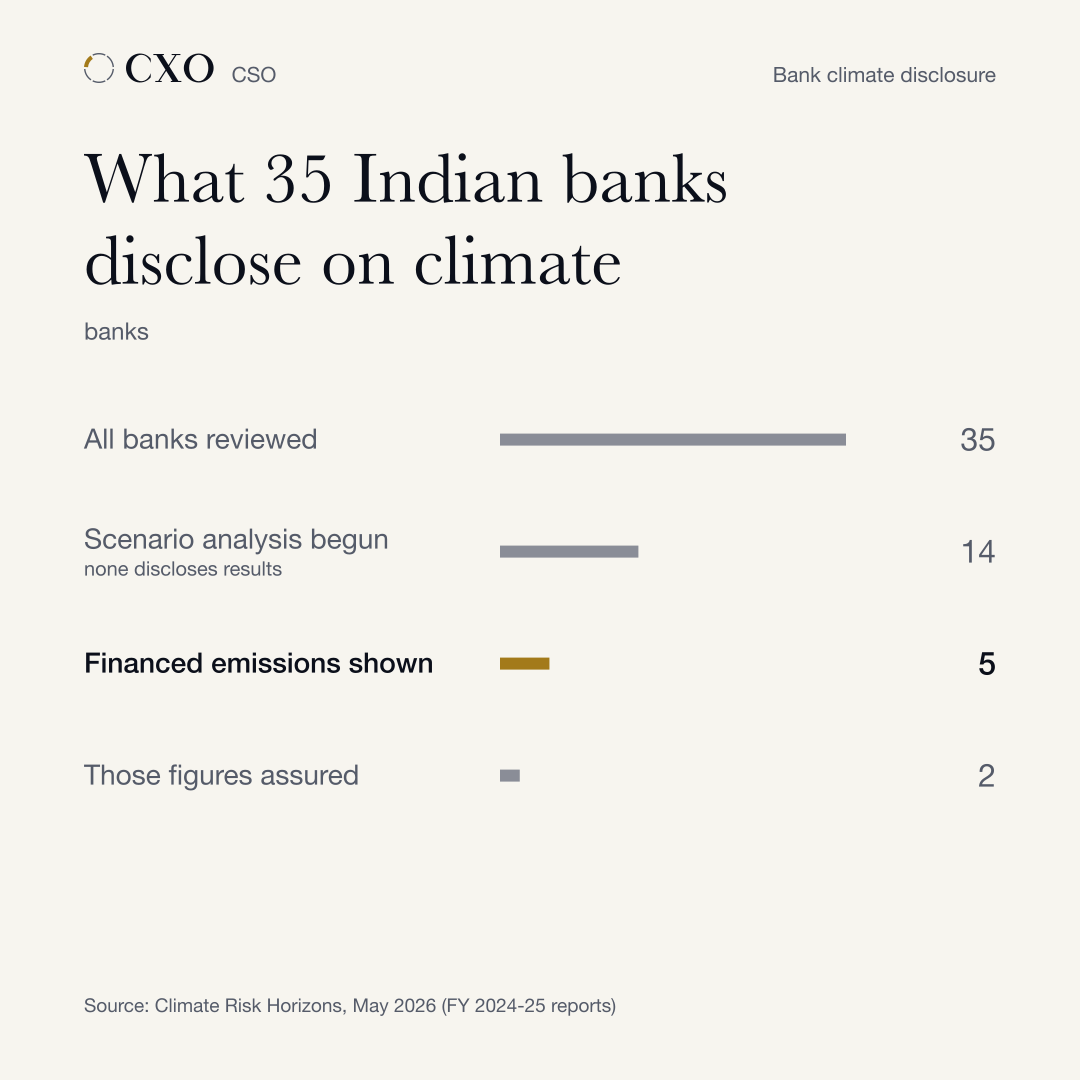
Banks are not waiting evenly. Climate Risk Horizons reviewed the 35 banks in the BSE top 1,000 for FY 2024-25 and published its findings in May 2026. Only five disclose financed emissions, and two of those have them assured. Fourteen say they have started climate scenario analysis or stress testing, and none publishes the results. SBI and PNB are the two banks whose net zero targets include Scope 3 emissions, which for a bank means its loan book.
European supervisors have moved from asking to fining. The ECB imposed periodic penalty payments of EUR 187,650 on Spain's ABANCA in November 2025 and EUR 7,551,050 on Credit Agricole in February 2026. In both cases the bank had missed a deadline to assess how material climate and environmental risks were to its business, by 65 and 75 days in 2024.
Our judgment is that the RBI will finalise the framework with a later start date, and that the large banks with Scope 3 targets will start asking carbon-heavy borrowers for emissions data before any rule obliges them to. We are wrong if the RBI has issued no final climate disclosure directions by 31 March 2028.
We would build the data once, at plant level, on the same definitions you use for BRSR Core, and offer it to your two largest lenders at the next renewal. A borrower that hands over a verified Scope 1 and 2 figure decides the number its lender reports. Without it, the lender has to estimate.
This is based on our research into public sources and is not legal advice. Check how it applies to your company with your lawyers and advisers.
Sources (5)
- Reserve Bank of India, Draft Disclosure framework on Climate-related Financial Risks, 2024 (28 February 2024)
- Angel One, RBI Postpones Mandatory Climate Risk Reporting for Banks (30 January 2026, reporting Reuters)
- Climate Risk Horizons, Small Steps for a Big Problem: Despite Climate Crisis, Indian Banks Stuck in Compliance Mode (May 2026)
- ECB Banking Supervision, ECB imposes periodic penalty payments on Credit Agricole (13 February 2026)
- Banque de France (ECB release), ECB imposes periodic penalty payments on ABANCA (10 November 2025)