
A CISO at a SEBI-regulated broker, fund house or depository participant has to decide what evidence the next cyber audit will see under the Cybersecurity and Cyber Resilience Framework, now that every adoption deadline has passed. SEBI's CSCRF circular of 20 August 2024 set adoption dates of 1 January 2025 for six categories of entities that already had cyber circulars and 1 April 2025 for the rest. After a March 2025 extension, SEBI's circular of 30 June 2025 extended compliance by two months to 31 August 2025 for all regulated entities except market infrastructure institutions, KYC registration agencies and qualified registrars.
For entities that also answer to RBI or another regulator, SEBI's technical clarifications of 28 August 2025 set two principles. Under exclusivity, CSCRF covers only systems used exclusively for SEBI-regulated activity, and SEBI audits shared infrastructure where the primary regulator does not. Under equivalence, controls such as the Cyber Capability Index, IT Committee composition and SOC efficacy are deemed met where the primary regulator's framework is followed. Entities must demonstrate which principle applies to each control, and SEBI may ask to see what they submitted to other regulators.
The same circular widened critical systems to include any system on the same network segment as a critical one, set a two-hour objective for resuming critical operations with a 15-minute recovery point, made mobile app security guidance and ISO 27001 certification recommended only, and directed entities to follow CERT-In's Comprehensive Cyber Security Audit Policy Guidelines. Portfolio managers with Rs 10,000 crore or more under management became mid-size entities, and inactive merchant bankers became exempt.
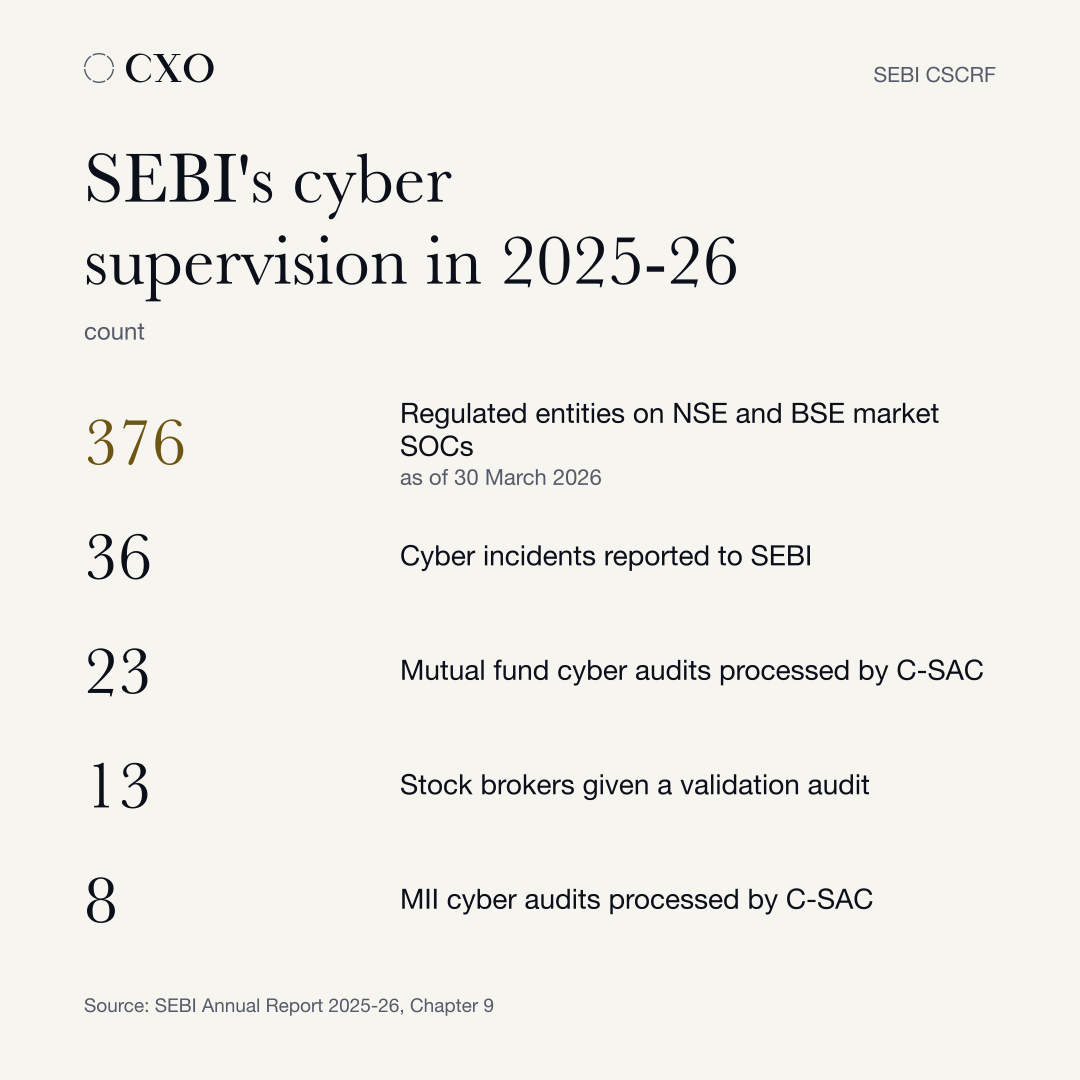
SEBI's Annual Report 2025-26 shows the supervision behind the rules. NSE and BSE set up market security operations centres in April 2025, and 376 regulated entities had joined them by 30 March 2026. Regulated entities reported 36 cyber incidents to SEBI during the year. SEBI ran special validation audits of 13 stock brokers, and its automated audit tool processed cyber audit reports for 8 market infrastructure institutions and 23 mutual funds.
Two circulars of 24 August 2026 add to this. Reports on SEBI's incident portal now follow the Financial Stability Board's FIRE format, filed in stages from first report to closure, alongside the existing duty to email SEBI within 6 hours and file on the portal within 24 hours. Market infrastructure institutions must run an IT Resilience Index, with availability and security weighted 20 each out of 100, operational by 28 February 2027 and first computed for the half-year ending 31 March 2027.
Our judgment is that the equivalence principle will produce the most audit findings in groups with a bank parent, because the CISO has to evidence, control by control, which regulator's rule is relied on and keep the other regulator's submissions to hand. We would build that mapping before the next audit cycle. We are wrong if SEBI's 2026-27 annual report shows validation-audit findings concentrated in stand-alone brokers with no second regulator.
This is based on our research into public sources and is not legal advice. Check how it applies to your company with your lawyers and advisers.
Sources (6)
- SEBI, Circular SEBI/HO/ITD-1/ITD_CSC_EXT/P/CIR/2024/113, Cybersecurity and Cyber Resilience Framework for SEBI Regulated Entities (20 August 2024)
- SEBI, Circular SEBI/HO/ITD-1/ITD_CSC_EXT/P/CIR/2025/96, Extension towards adoption and implementation of CSCRF (30 June 2025)
- SEBI, Circular SEBI/HO/ITD-1/ITD_CSC_EXT/P/CIR/2025/119, Technical clarifications to CSCRF (28 August 2025)
- SEBI, Annual Report 2025-26, Chapter 9: Technology
- SEBI, Circular HO/(449)2026-ITD-5_DIV1/I/19448/2026, Alignment of SEBI's Cyber Incident Reporting Portal with FIRE format (24 August 2026)
- SEBI, Circular HO/47/18/11(1)2026-MRD-TPD1/I/19509/2026, IT Resilience Index for MIIs (24 August 2026)