
A CISO has to decide now who in the company declares a personal data breach, because under the Digital Personal Data Protection Rules the reporting clock runs from awareness and applies to any personal data breach. The Rules were notified on 13 November 2025 as G.S.R. 846(E). Rule 1 brings Rules 3, 5 to 16, 22 and 23 into force eighteen months after publication, which places the security and breach duties in Rules 6 and 7 on 13 May 2027.
Rule 7 sets two duties. Each affected Data Principal must be told without delay, in plain language, through her user account or registered contact: what happened, the likely consequences for her, the mitigation under way, the steps she can take and a business contact. The Board must receive a description of the breach without delay, covering its nature, extent, timing, location and likely impact. Within seventy-two hours of awareness, or a longer period the Board allows on written request, the company must add detailed facts, the reasons for the breach, findings about the person who caused it, remedial measures and a report on the notices sent to individuals.
Rule 6 sets the minimum safeguards that make such a report possible: encryption, masking or tokenisation, access control, logs with monitoring and review to detect unauthorised access, backups for continued processing, and contract terms that bind Data Processors to the same safeguards. It requires logs and personal data kept for detection and investigation to be retained for one year unless another law requires otherwise. Rule 13 adds a yearly Data Protection Impact Assessment and audit for Significant Data Fiduciaries.
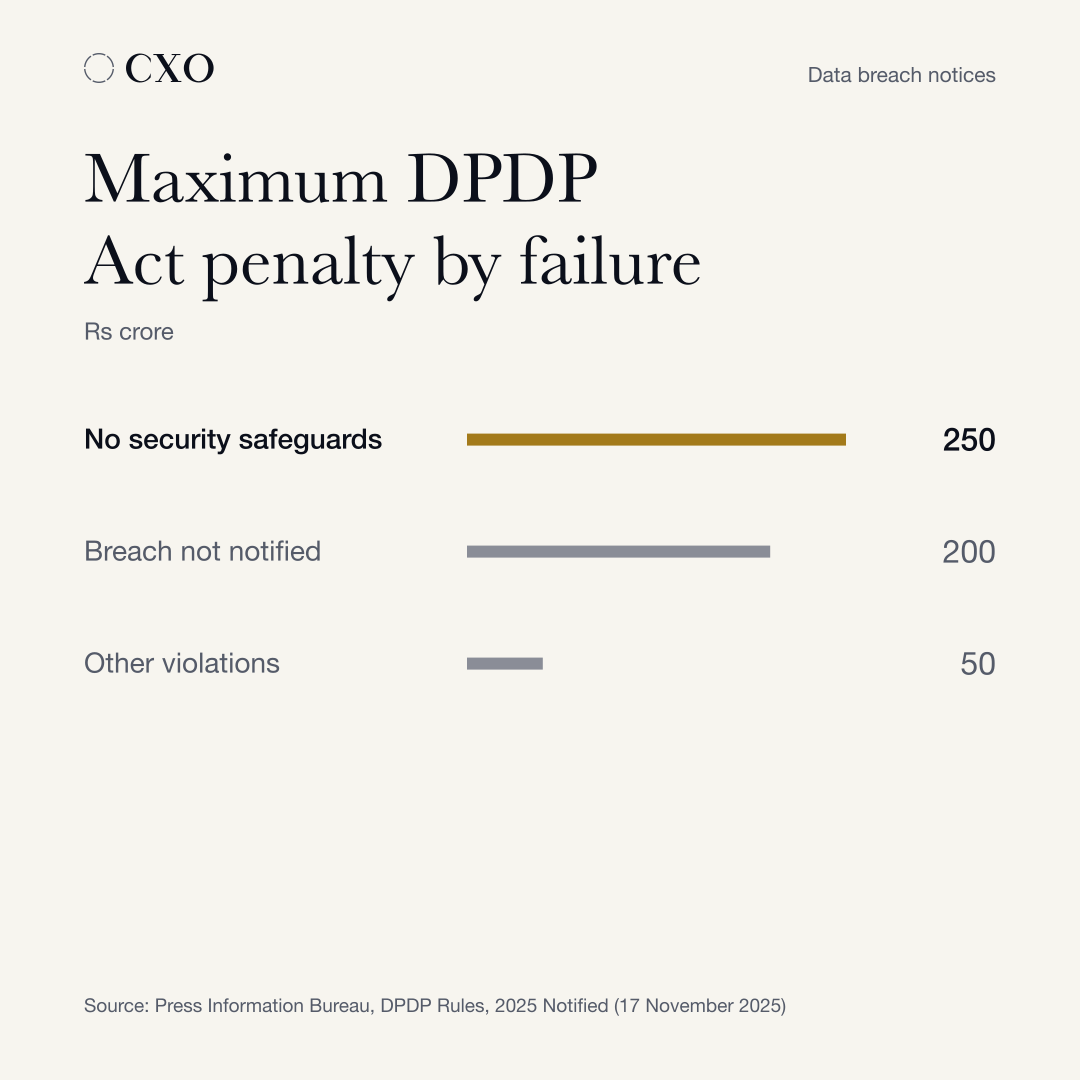
The penalties are set in the Act. The Press Information Bureau's explainer of 17 November 2025 lists up to Rs 250 crore for failing to maintain reasonable security safeguards, up to Rs 200 crore for not notifying the Board or affected individuals of a breach, and up to Rs 50 crore for other violations.
The date has held so far. S.S. Rana & Co. reported in February 2026 that MeitY had consulted industry on cutting the window for Significant Data Fiduciaries from 18 months to 12, with comments due by 4 February 2026. India Briefing reported a Removal of Difficulties Order issued on 5 October 2026 that made textual corrections to sections 9 and 10 of the Act. In our search we found no notification that moves 13 May 2027.
Our judgment is that the 72-hour report will be the harder duty, because it asks for cause, culprit and fixes, which depend on a year of searchable logs and on processors who report quickly. We would rewrite processor contracts to require breach notice within hours, test log retention against the one-year rule, draft both notices in advance and run a timed exercise before March 2027. We are wrong if, once the Board starts receiving reports, it routinely grants longer periods on written request, which would make 72 hours a soft target.
This is based on our research into public sources and is not legal advice. Check how it applies to your company with your lawyers and advisers.
Sources (4)
- Ministry of Electronics and Information Technology, Digital Personal Data Protection Rules, 2025, G.S.R. 846(E), Gazette of India, 13 November 2025 (copy hosted at dpdpa.com)
- Press Information Bureau, DPDP Rules, 2025 Notified: A Citizen-Centric Framework for Privacy Protection and Responsible Data Use (17 November 2025)
- S.S. Rana & Co., MeitY plans to cut short DPDP compliance timeline and notify cross border restrictions for SDFs (13 February 2026)
- India Briefing, DPDP Removal of Difficulties Order 2026 (7 October 2026)