
An Indian group with an Australian subsidiary has to decide this year whether to build that subsidiary's climate numbers centrally, to the IFRS-based Australian standard AASB S2, or leave them to the local finance team. Where the group's systems collect the energy, fuel and supplier data, the subsidiary's first report depends on work done in India.
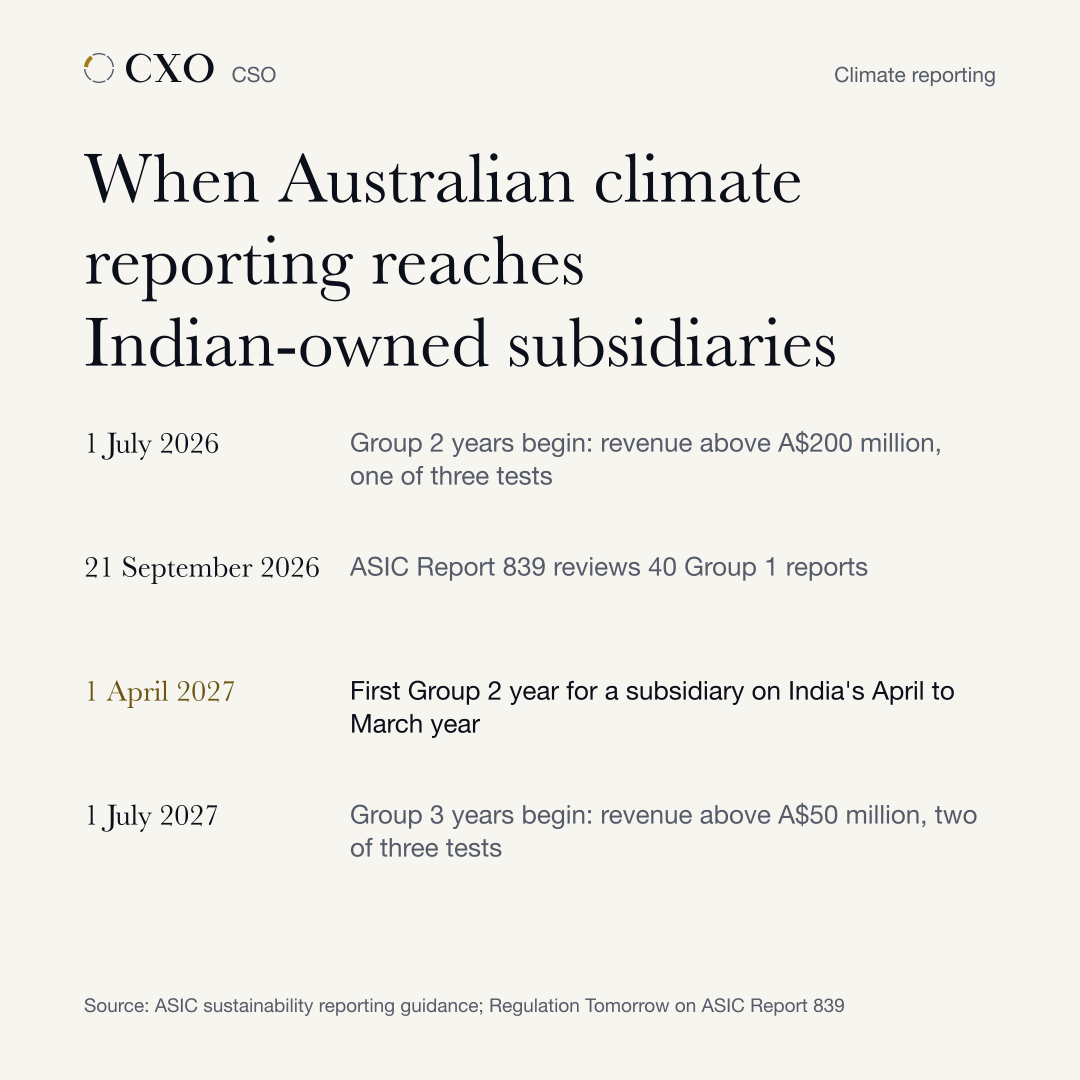
An entity that prepares an annual financial report under Chapter 2M of the Corporations Act must report if it meets the thresholds, ASIC says. Its guidance puts an entity in Group 2 if it meets two of three tests: revenue above A$200 million, assets above A$500 million or more than 250 employees. Group 2 reports for financial years beginning on or after 1 July 2026, so a subsidiary on India's April to March year starts with the year beginning 1 April 2027. Group 3, with revenue above A$50 million, assets above A$25 million or more than 100 employees, two of three again, follows from 1 July 2027, though ASIC notes the government is consulting on raising the large proprietary company thresholds, which may take some Group 3 entities out. Under AASB S2, scope 3 emissions are not required in the first annual reporting period.
The regulator is reading the reports. ASIC's Report 839 of 21 September 2026 reviewed 40 sustainability reports from Group 1 companies and found clear room for improvement in forward-looking disclosures, especially strategy and metrics and targets, according to a Regulation Tomorrow summary. By then the December 2025 year-end cohort had lodged 312 reports.
Japan is phasing in its largest listed companies first. Its Financial Services Agency requires Prime-market companies with a market value of 3 trillion yen or more to report under the ISSB-based SSBJ standards from the year ending March 2027, those between 1 and 3 trillion yen from March 2028, and those between 500 billion and 1 trillion yen from March 2029. The IFRS Foundation said on 18 August 2026 that more than 45 jurisdictions are using ISSB standards and that companies in 18 jurisdictions will be issuing reports by 2027. India's BRSR is a different format, and we found no SEBI timetable for adopting IFRS S2.
Our judgment is that Australia keeps the 1 July 2027 start for Group 3 while it raises the proprietary company thresholds. We are wrong if the government defers that start date.
We would build one group greenhouse gas inventory that can be cut by legal entity, so the Australian company can report scopes 1 and 2 in its first year and scope 3 in its second without a separate data project. BRSR data is gathered by Indian plant and will not cover the subsidiary on its own.
This is based on our research into public sources and is not legal advice. Check how it applies to your company with your lawyers and advisers.
Sources (6)
- ASIC, Sustainability reporting for small business (group thresholds and start dates)
- ASIC, Sustainability reporting (threshold consultation note)
- AASB, AASB S2 Appendix C, Effective date and transition
- Regulation Tomorrow, ASIC's review of mandatory sustainability reports: progress noted but work remains (September 2026), summarising ASIC Report 839
- Financial Services Agency of Japan, Japanese Roadmap on Sustainability Disclosure and Assurance (2026)
- IFRS Foundation, Trustees announce five-year plan (18 August 2026)