
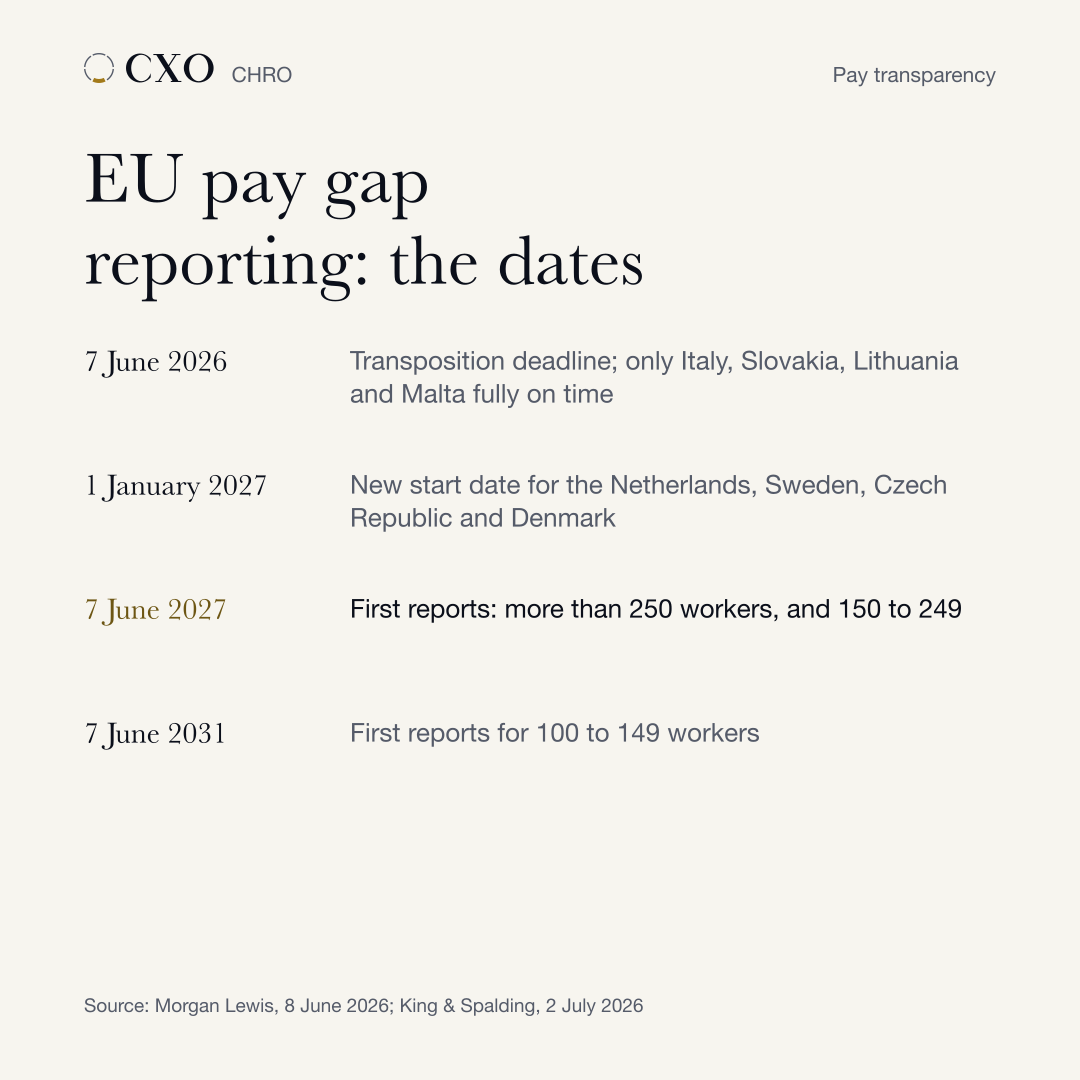
A CHRO at an Indian group with European subsidiaries has to decide this quarter whether to audit pay by job level in each EU entity now, before most member states have written their national rules. Under the EU Pay Transparency Directive, Morgan Lewis reported on 8 June 2026, employers with more than 250 workers must publish a gender pay gap report by 7 June 2027 and every year after, those with 150 to 249 by the same date and every three years, and those with 100 to 149 by 7 June 2031.
Most governments missed the 7 June 2026 deadline the Commission set. King & Spalding wrote on 2 July that only Italy, Slovakia, Lithuania and Malta had fully transposed. Morgan Lewis listed the Netherlands, Sweden, the Czech Republic and Denmark as delayed to 1 January 2027, and Littler reported that Germany had no law and Ireland had said it would be late. Where a state has not transposed, Morgan Lewis says the duties do not specifically apply to employers, though courts may read existing equal pay law in their light.
The content is settled even where the national law is late. A gap of at least 5% in any category of workers that is not objectively justified, and not fixed within six months, leads to a joint pay assessment with workers' representatives, King & Spalding summarises. Candidates get pay information before the interview, employers may not ask about salary history, and the burden of proof in pay claims shifts to the employer.
The UK already requires employers with 250 or more employees to report every year, so one Indian employer's number is public. Tata Consultancy Services' UK filing for the snapshot of 5 April 2025 shows women's median hourly pay 11.5% below men's and the mean 14.8% below, with women making up 11.0% of the top pay quarter. In India, the four Labour Codes took effect on 21 November 2025, and SCC Online's summary of the government's release lists gender-neutral pay and opportunities, including protections for transgender persons.
Our judgment is that fewer than half of the 27 member states will have full transposing laws in force on 7 June 2027. We are wrong if 14 or more do.
We would run the audit on 2026 pay now for every EU entity with 150 or more staff, using the same job levels as in India, and drop the salary history question from European application forms this month. A late national law moves the filing date, while the 5% test and the hiring rules arrive in the same form whenever each state acts.
This is based on our research into public sources and is not legal advice. Check how it applies to your company with your lawyers and advisers.
Sources (7)
- Morgan Lewis, EU Pay Transparency Directive: the deadline for transposition has passed, what now? (8 June 2026)
- King & Spalding, The EU Pay Transparency Directive: where do we stand? (2 July 2026)
- Littler, Did member states meet the deadline? Status of implementation of the EU Pay Transparency Directive (8 June 2026)
- European Commission, EU action for equal pay
- UK Government, Gender pay gap reporting: who needs to report
- UK gender pay gap service, Tata Consultancy Services Limited, reporting year 2025 to 2026
- SCC Online, Four Labour Codes, summarising the government's release (21 November 2025)