
A CMO who runs creator campaigns through an agency has to decide whether to keep paying on delivery or to hold the final payment until someone checks that each live post is labelled as an ad. ASCI's annual complaints report for 2025-26 suggests the check is overdue. Of the 1,609 influencer ads ASCI processed in the year, 97.3% required modification, Campaign India reported on 30 May 2026.
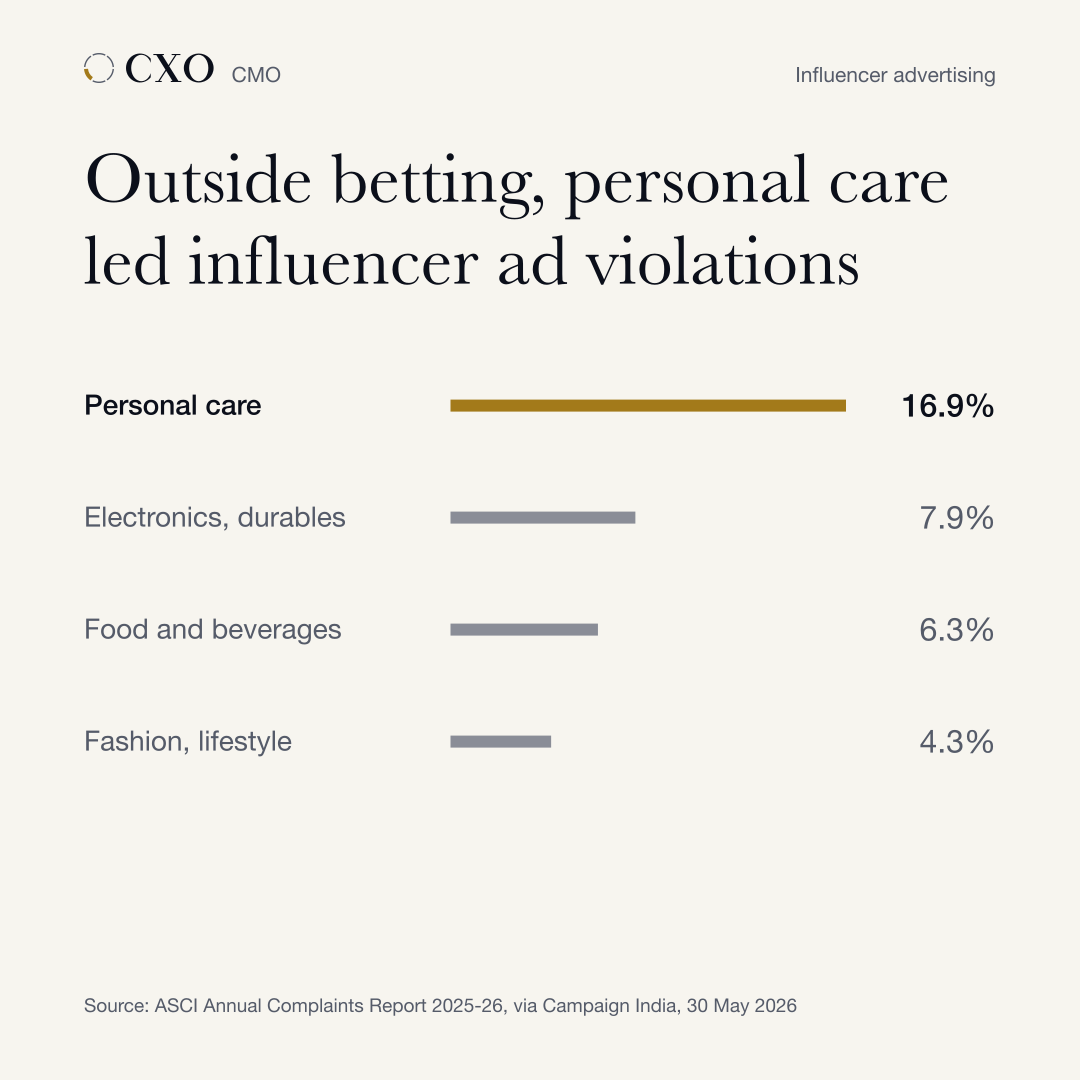
Most of that is illegal betting, which made up 54% of influencer violations. The rest is where mainstream brands sit: personal care at 16.9%, electronics and consumer durables at 7.9%, food and beverages at 6.3%, and fashion and lifestyle at 4.3%. Across all media ASCI reviewed 11,581 cases, 21% more than a year earlier, and 93% of them came from its own monitoring. Overall compliance rose to 86% from 83%.
ASCI is a self-regulatory body. The statutory risk sits under section 21 of the Consumer Protection Act, 2019. The Central Consumer Protection Authority can fine a manufacturer or endorser up to Rs 10 lakh for a false or misleading advertisement and up to Rs 50 lakh for each later breach, and can bar an endorser from endorsing for up to one year, or three years for a repeat. The due-diligence defence in section 21(5) is written for endorsers who verified the claims.
The UK measures the whole market. Its Advertising Standards Authority used an AI monitoring system on more than 50,000 Instagram and TikTok posts and found about 57% of influencer content likely to be adequately disclosed, Lewis Silkin reported in May 2025. Among accounts first monitored in 2021, adequate disclosure rose from 35% to 49% by 2024. Since April 2025 the UK's competition authority has been able to fine up to 10% of global turnover for consumer law breaches without going to court, Sidley reported. The 97% Indian figure covers only ads ASCI picked out, so the two numbers are not comparable.
We expect ASCI's 2026-27 annual report to show more than 1,609 influencer ads processed, because its own scanning already finds most cases. We are wrong if the count falls.
We would write the disclosure label into every brief and contract, hold the last payment until a person has seen the live post, and keep that record for each creator. If the CCPA ever examines a campaign, that record shows what the brand checked and when.
This is based on our research into public sources and is not legal advice. Check how it applies to your company with your lawyers and advisers.
Sources (5)
- Campaign India, ASCI report highlights rise in digital advertising violations (30 May 2026), reporting ASCI's Annual Complaints Report 2025-26
- ASCI, Annual Complaints Report 2025-26 (PDF)
- Consumer Protection Act, 2019, section 21 (AdvocateKhoj bare act)
- Lewis Silkin, ASA publishes new report on influencer transparency (9 May 2025)
- Sidley, New UK consumer rules herald stricter enforcement and significant fines (8 April 2025)