
A CISO now has to decide which AI systems sit at Moderate tier or above, because CERT-In's AI Security Auditing Guidelines, version 1.0, dated 4 November, attach an independent audit by a CERT-In-empanelled auditor, at least once a year, to that tier. The guidelines cover AI systems an organisation in India develops, procures, deploys or operates, and they list third-party proprietary models among the systems in scope, so a bought model sits inside the buyer's audit.
The tier comes from a score across eight factors, including impact severity, autonomy, data sensitivity and sector criticality. High systems need periodic independent audits, every six months where risk or a material change warrants it, and Critical systems need an empanelled audit with continuous monitoring. Third-party and AI supply-chain assurance is one of the nine core audit domains, which is where a vendor's model gets examined. Reportable AI incidents go to CERT-In within six hours, and logs must be kept for 180 days.
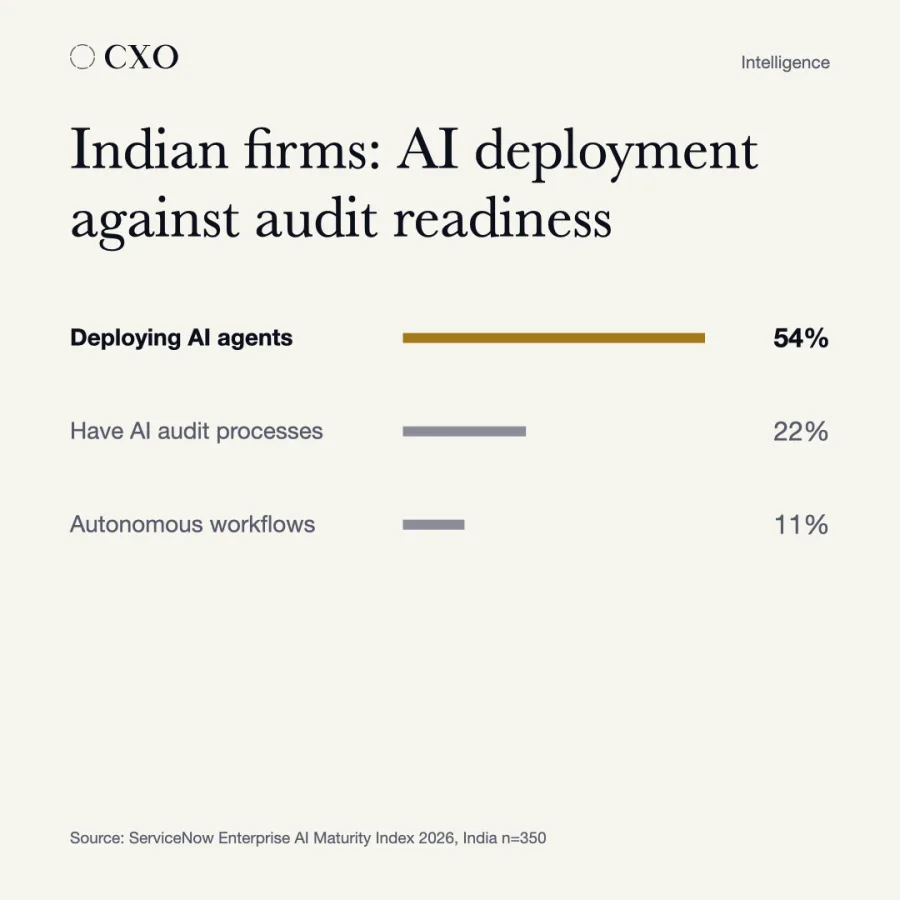
ServiceNow's Enterprise AI Maturity Index, released on 8 September from a survey of 4,500 senior leaders, 350 of them in India, found 54% of Indian organisations deploying AI agents and 22% with AI testing, auditing and risk-assessment processes. The guidelines score autonomy higher as a system moves from advisory output to starting actions on its own, so an agent that acts pushes its score up. ServiceNow sells AI workflow software, so its percentages are a vendor's survey.
The 107-page document uses mandatory language and refers to a mandatory compliance scope, yet it does not name the provision of law it is issued under, gives no effective date and sets no penalty. It says escalation to an outside authority happens only where another applicable requirement calls for it. Its six-hour reporting and 180-day log rules point back to CERT-In's directions of 28 April 2022, which CERT-In issued under section 70B(6) of the IT Act.
The EU delayed its heaviest AI duties and left others in place. Regulation (EU) 2026/1744, published in the Official Journal on 24 July, moved obligations for stand-alone high-risk systems from 2 August 2026 to 2 December 2027, and for AI inside regulated products to 2 August 2028, according to the Regulation's own text and K&L Gates' note. The EU dates have no force in India.
We would run the six-hour incident path as a tabletop exercise this quarter, because it needs only your own people and applies whatever tier a system lands in. Vendor contracts come next. On a closed model the buyer holds neither the test results nor the full logs. The guidelines expect contracts with AI providers to set out audit and assurance rights, and where the auditor cannot get access they say it should use other evidence, such as API testing and the provider's own attestations, and that missing access does not count as conformity. Ask each vendor which test results and logs it will release to your empanelled auditor, and put a line for the audit itself in the FY28 budget.
This is based on our research into public sources and is not legal advice. Check how it applies to your company with your lawyers and advisers.
Sources (6)
- CERT-In, Artificial Intelligence (AI) Security Auditing Guidelines v1.0 (4 Nov 2026), copy hosted by MediaNama
- MediaNama, Lowdown: CERT-In's AI Security Auditing Guidelines (6 Nov 2026)
- ServiceNow Newsroom, Enterprise AI Maturity Index 2026 India release (8 Sep 2026)
- K&L Gates via The National Law Review, EU Digital Omnibus on AI enters into force (31 Jul 2026)
- CERT-In, Directions under section 70B(6) of the IT Act, No. 20(3)/2022-CERT-In, 28 April 2022
- Regulation (EU) 2026/1744 (Digital Omnibus on AI), OJ L 24.7.2026, ELI