
A company planning a large bond for solar, storage or efficiency projects has to decide whether to label it green. SEBI's circular of 27 February 2026 says the issuer of green debt securities shall appoint an independent third-party reviewer to check that the issue meets the green definition, including how projects are evaluated and selected. The reviewer must be independent of the issuer's directors and management, paid in a way that prevents conflicts of interest, and expert in ESG debt, and the scope of its review goes in the offer document.
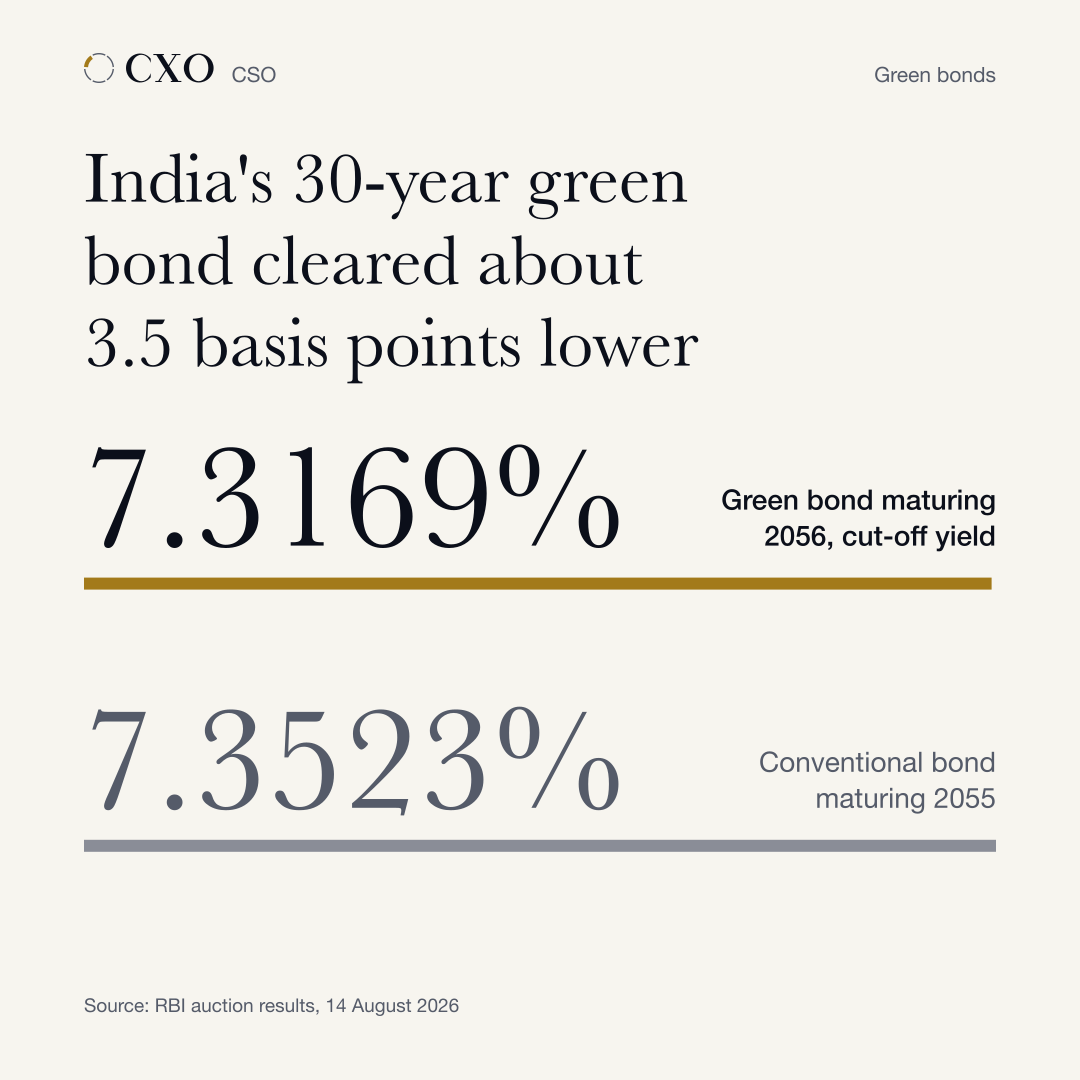
The price benefit is small even for the sovereign. At the RBI auction of 14 August 2026, the 7.50% sovereign green bond maturing in 2056 cleared at a yield of 7.3169%. The same day, the conventional 7.24% bond maturing in 2055 cleared at 7.3523%. That is a gap of about 3.5 basis points, between bonds a year apart in maturity. In June 2025 the RBI rejected every bid for a 30-year green bond, Angel One reported, although bids of Rs 10,943.5 crore came in for Rs 5,000 crore on offer, because investors wanted higher yields than the government would pay.
Germany runs the cleanest test, issuing each green bond as a twin of a conventional one. Its finance agency's 2025 allocation report puts the yield gap on its 2025 green auctions between about 0.4 and 2.0 basis points, and around 1.4 basis points on the 30-year green bond.
More supply is coming. The RBI's calendar for October 2026 to March 2027 lists Rs 3,000 crore of 30-year sovereign green bonds in each of five auction weeks, Rs 15,000 crore in all, with the next in the week of 23 November.
Our judgment is that a corporate issuer in India should expect no measurable price gain from the label, since the sovereign itself gets only a few basis points. We are wrong if any of the five green auctions in this calendar clears more than 10 basis points below the conventional 2055 bond's market yield on the same day.
We would label a bond green only when the capex already qualifies and the treasury wants to reach investors with green mandates, and we would leave any greenium out of the business case. Budget for the reviewer and for annual reporting on how the money was spent. Since the circular requires a reviewer that is independent and paid in a way that avoids conflicts, we would pick one with no other work for the company.
This is based on our research into public sources and is not legal advice. Check how it applies to your company with your lawyers and advisers.
Sources (5)
- SEBI, Circular on revised norms for appointment of an independent third-party reviewer/certifier for green debt security (27 February 2026, NSDL copy)
- Reserve Bank of India, Government Stock Auction Results: Cut-off (14 August 2026)
- Angel One, RBI declines all bids of sovereign green bonds at weekly bond auction (June 2025)
- Finanzagentur (German Finance Agency), Green Bond Allocation Report 2025
- Reserve Bank of India, Indicative calendar for market borrowing, October 2026 to March 2027 (25 September 2026)