
A CXO who invests through angel funds registered on or before 10 September 2025 has until 31 March 2027 to become an accredited investor. After that date, an angel fund registered on or before 10 September 2025 cannot accept money from a non-accredited investor for any investment in a startup. SEBI's circular of 7 September 2026 moved the date from 8 September 2026, and existing investors keep their holdings. Angel funds registered after 10 September 2025 already take accredited investors only.
A serving executive mostly faces paperwork. Deloitte India's Executive Performance and Rewards Survey 2026, released on 30 March 2026, puts median CFO pay at ₹4.5 crore, above the accredited test of ₹2 crore in annual income, though a median says nothing about you.
Under SEBI's circular of 5 November 2026, accreditation by a fund manager and an accreditation agency's certificate both last three years. A manager outside the group of the manager that accredited you must determine your status afresh at each onboarding, while a manager handed a valid agency certificate must rely on it. An investor who is accredited on joining a scheme stays accredited for the rest of that scheme's life. The circular's manager route covers the manager of any AIF, and an angel fund is a sub-category of Category I AIF, so angel fund managers can use it. Cheques written through unrelated funds favour the agency certificate, and one group's funds make the manager route enough.
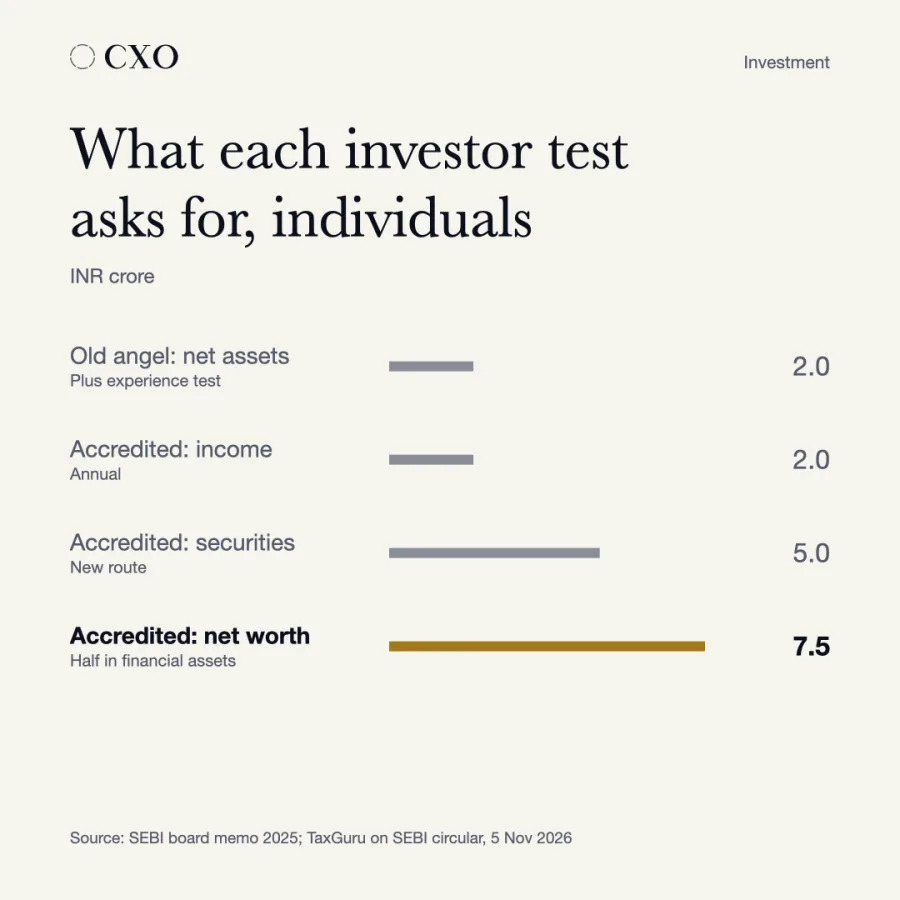
A retired executive faces a harder test. The old angel test asked for ₹2 crore of net tangible assets excluding the home, plus experience such as 10 years in senior management. The accredited tests for an individual, in regulation 2(1)(ab) of the AIF Regulations as amended on 15 October 2026, are ₹2 crore of annual income; ₹7.5 crore of net worth with at least ₹3.75 crore in financial assets; ₹1 crore of income with ₹5 crore of net worth, of which ₹2.5 crore is financial assets; or ₹5 crore of securities market exposure. SEBI's AIF master circular leaves the home out of net worth, and a long career counts in none of the tests. A retiree with ₹2 crore of assets and modest income meets none, while one with ₹1 crore of income and ₹5 crore of net worth, at least ₹2.5 crore of it in financial assets, qualifies.
Check each fund's registration date and apply by the route your spread of funds dictates. SEBI has extended this deadline once, and we would not count on another. Anyone who cannot qualify keeps existing stakes but cannot put new money into startups through these funds after 31 March 2027.
This is based on our research into public sources and is not legal advice. Check how it applies to your company with your lawyers and advisers.
Sources (11)
- CAclubindia reproduction of SEBI circular, Relaxation in timeline with respect to Accredited Investor mandate for Angel Funds
- TaxGuru summary of SEBI circular HO/19/34/11(6)2026-AFD-POD1/I/25244/2026
- SEBI board memorandum, Review of regulatory framework for Angel Funds under AIF Regulations, Annexure A Part III
- Deloitte India press release, Median CEO pay in India stands at INR 10.5 crore for FY 2025-26
- SEBI, Relaxation in timeline with respect to Accredited Investor mandate for Angel Funds, circular of 7 September 2026
- TaxGuru, Class of investors: accredited investors (summary of SEBI circular of 26 August 2021), 14 September 2021
- SEBI circular HO/19/34/11(7)2025-AFD-POD1/I/20626/2026, 7 September 2026 (PDF)
- SEBI circular HO/19/34/11(6)2026-AFD-POD1/I/25244/2026, Review of the framework for Accredited Investors, 5 November 2026 (PDF)
- SEBI (Alternative Investment Funds) Regulations, 2012, consolidated as last amended on 15 October 2026, regulation 2(1)(ab) and Chapter III-A
- SEBI (Alternative Investment Funds) (Third Amendment) Regulations, 2026, notified 9 October 2026, in force 15 October 2026
- SEBI Master Circular for AIFs, 7 May 2024, Chapter 12 para 1.3 (primary residence excluded from net worth)