
A CEO whose demat balance is mostly employer stock can qualify as an accredited investor on that stock. SEBI's Board approved a securities route of ₹5 crore on 24 September, and the amended AIF Regulations took effect on 15 October. SEBI's circular of 5 November counts securities held in demat form, mutual fund folios, unlisted securities held in demat form, overseas securities market investments and National Pension System investments, with no carve-out for shares in your employer, and SEBI's board memo shows it chose a gross measure knowing it leaves out liabilities (para 5.3). Demat holdings count at the value in your eCAS statement, and unlisted or overseas holdings the eCAS does not value need a practising chartered accountant's certificate. The circular names only holdings, and the memo says the route is meant to capture actual holdings (para 5.19), so on that wording unvested RSUs and unexercised options do not count. Vested shares in an overseas listed parent fit the overseas securities market category, though the circular does not mention employee share plans, and unlisted employer shares count only once they are held in demat form.
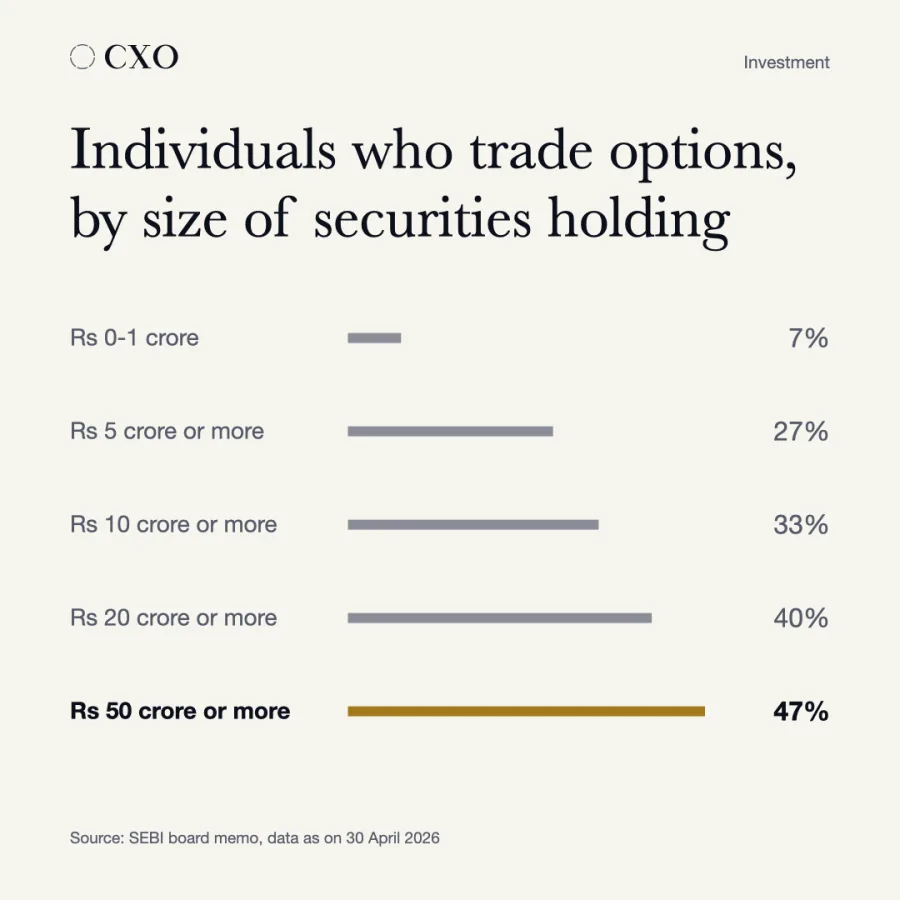
SEBI's stated aim is to find investors with both the financial capacity to absorb losses and the willingness to take risk. Its table speaks to the second half alone. Of individuals holding ₹5 crore or more, 27% trade options, about four times the share in the bracket below ₹1 crore, on depository and exchange data as at 30 April 2026. The table describes all holders at each level and says nothing specific about CXOs.
Capacity is where employer stock fails. The asset that qualifies you depends on the same company as your salary and unvested equity, which is the opposite of the loss capacity the route is meant to show. No source we opened measures this concentration among Indian CXOs, so you will need your own number.
The board memo estimates that about 3.7 lakh investors would have met the proposed criteria on data as at 30 April 2026, against around 96,000 current AIF investors. Distributors now have a much longer list of people to call.
SEBI considered adjusting holdings for borrowings or encumbrances and rejected it, because the test has to run from a depository or broker statement without manual checks (memo para 5.18). The circular sets no deduction for pledged shares, so shares with a loan against them still count at their eCAS value. When a distributor calls, size any illiquid commitment to what you own outside the employer, less any loan against those shares.
This is based on our research into public sources and is not legal advice. Check how it applies to your company with your lawyers and advisers.
Sources (5)
- SEBI board memorandum, Proposals to review the Accredited Investor framework
- SEBI PR No. 59/2026, Key decisions taken in the SEBI Board Meeting
- TaxGuru summary of SEBI circular HO/19/34/11(6)2026-AFD-POD1/I/25244/2026
- SEBI circular HO/19/34/11(6)2026-AFD-POD1/I/25244/2026, Review of the framework for Accredited Investors, 5 November 2026 (PDF)
- SEBI (Alternative Investment Funds) (Third Amendment) Regulations, 2026, notified 9 October 2026, in force 15 October 2026