
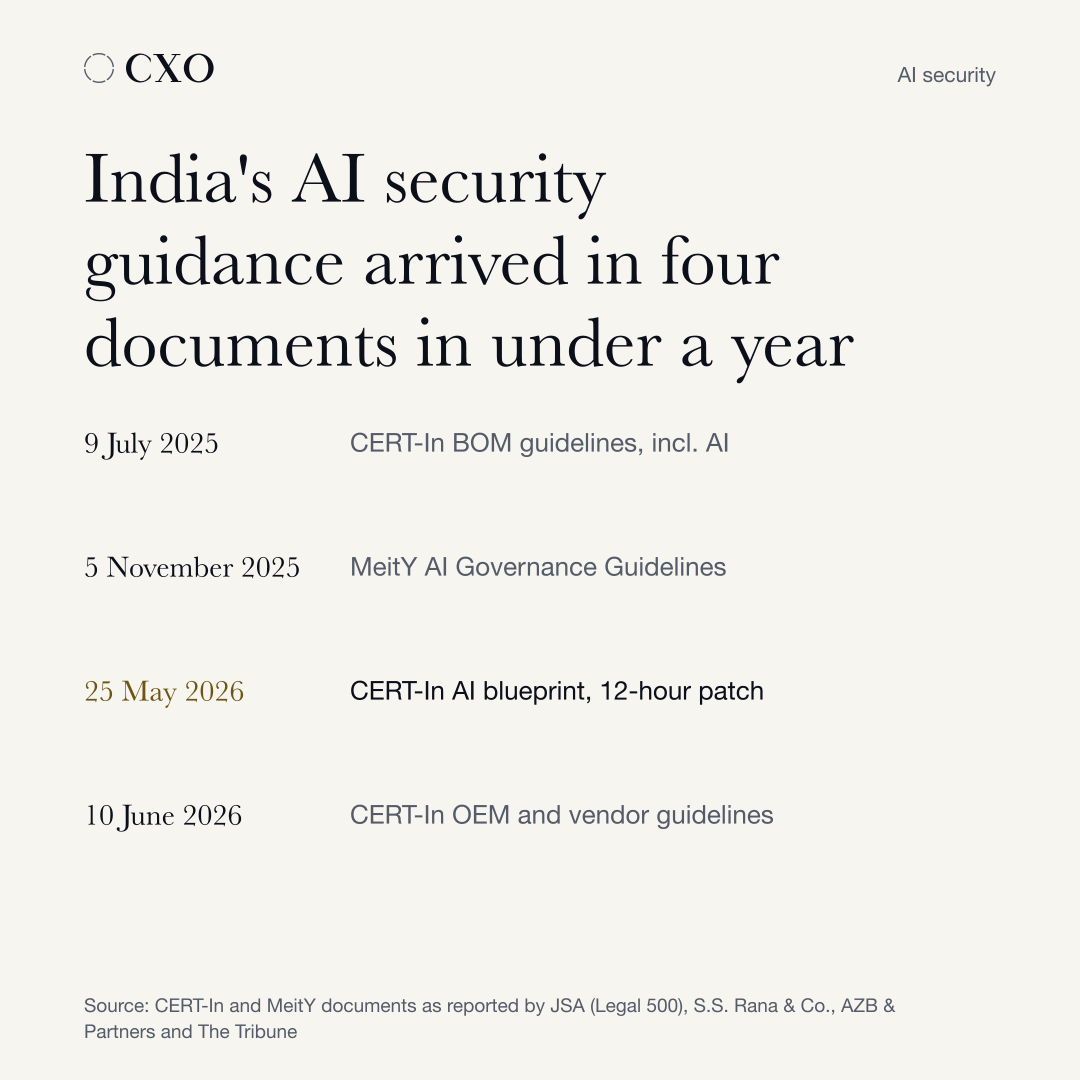
A CISO whose company has put generative AI into customer service, software development or internal search now has to decide who owns the list of those systems and how fast their flaws get fixed. On 25 May 2026 CERT-In issued its Blueprint for Reducing Exposure and Defending against AI-Assisted Vulnerabilities Exploitation in Digital Infrastructure. As reported by JSA Advocates & Solicitors in Legal 500, it asks organisations to "maintain inventories of AI systems and AI integrations" and to "validate model provenance and integrity".
The patch targets are the sharper change. Known exploited vulnerabilities on internet-facing or crown jewel systems should be contained and patched within 12 hours where feasible, critical externally exposed vulnerabilities within one day, and high-severity vulnerabilities generally within five days. The blueprint also asks for AI-generated code to be reviewed through static application security testing, and for AI activity to be logged and monitored. JSA notes that it is presently framed as guidance and is not binding regulation. The six-hour incident reporting duty under CERT-In's directions of 28 April 2022 still applies.
Suppliers are asked for more. S.S. Rana & Co. reports that CERT-In guidelines dated 10 June 2026 expect OEMs and technology providers to keep a live bill of materials "shared with Indian customers and CERT-In and kept current", and to set patch deadlines by whether AI could plausibly exploit a flaw: 7 days for a high-severity flaw that AI could exploit in IT systems, against 15 days under standard disclosure. The firm says enforcement has not formally begun. CERT-In's technical guidelines of 9 July 2025, as reported by AZB & Partners, already list 12 minimum elements for an AI bill of materials, from model name and version to adversarial testing results, and describe that framework as voluntary.
The wider policy stays light. MeitY released the India AI Governance Guidelines on 5 November 2025 with seven principles, the last being Safety, Resilience & Sustainability. S.S. Rana & Co. summarises their position as relying on existing regulation for many risks and on voluntary measures for emerging ones. For engineering teams, the OWASP Top 10 for LLM Applications 2025 is the shared checklist: prompt injection is LLM01, supply chain LLM03, excessive agency LLM06 and system prompt leakage LLM07.
Our judgment is that the AI inventory and the 12-hour window will move from guidance into sector regulators' rules or CERT-In audit scopes, so a CISO should treat the blueprint's windows as the internal standard now. We are wrong if neither CERT-In, RBI, SEBI nor IRDAI makes an AI system inventory or the 12-hour window a requirement by 31 December 2027.
We would do three things this quarter: list every AI model and integration with a named owner, ask each AI supplier for its AI bill of materials against CERT-In's 12 elements, and rehearse the 12-hour path once on a real exploited flaw so the board sees an actual time.
This is based on our research into public sources and is not legal advice. Check how it applies to your company with your lawyers and advisers.
Sources (6)
- JSA Advocates & Solicitors via Legal 500, CERT-In issues blueprint for defending against AI-assisted vulnerabilities exploitation (16 June 2026)
- S.S. Rana & Co., CERT-In's New AI-Vulnerability Guidelines: A Quick-Reference for OEMs, Tech Vendors and In-House Counsel (23 July 2026)
- AZB & Partners, CERT-In's new BOM guidelines: what India's software, AI and hardware ecosystem needs to know (29 July 2025)
- The Tribune (ANI), MeitY unveils India AI Governance Guidelines (5 November 2025)
- S.S. Rana & Co., MeitY Unveils India AI Governance Guidelines (6 November 2025)
- OWASP Gen AI Security Project, Top 10 for LLM Applications 2025