

A fractional finance leader whose work for a listed Indian company gives access to price sensitive information remains a connected person for six months after the work ends, and that tail decides whether the mandate can sit beside a personal portfolio or a second listed client. Section 203 of the Companies Act requires a listed company to have a whole-time CFO, so the fractional role here is advisory.
SEBI's Third Amendment to the insider trading regulations, in force from 6 December 2024 and read in SEBI's consolidated text, defines a connected person as anyone who is or has been associated with the company in any capacity during the six months before the act in question. It names contractual, fiduciary and employment relationships, and professional or business ones "whether temporary or permanent", where the relationship allows access to unpublished price sensitive information or is reasonably expected to. A retainer that brings board papers fits that wording. Being connected does not by itself show any wrongdoing.
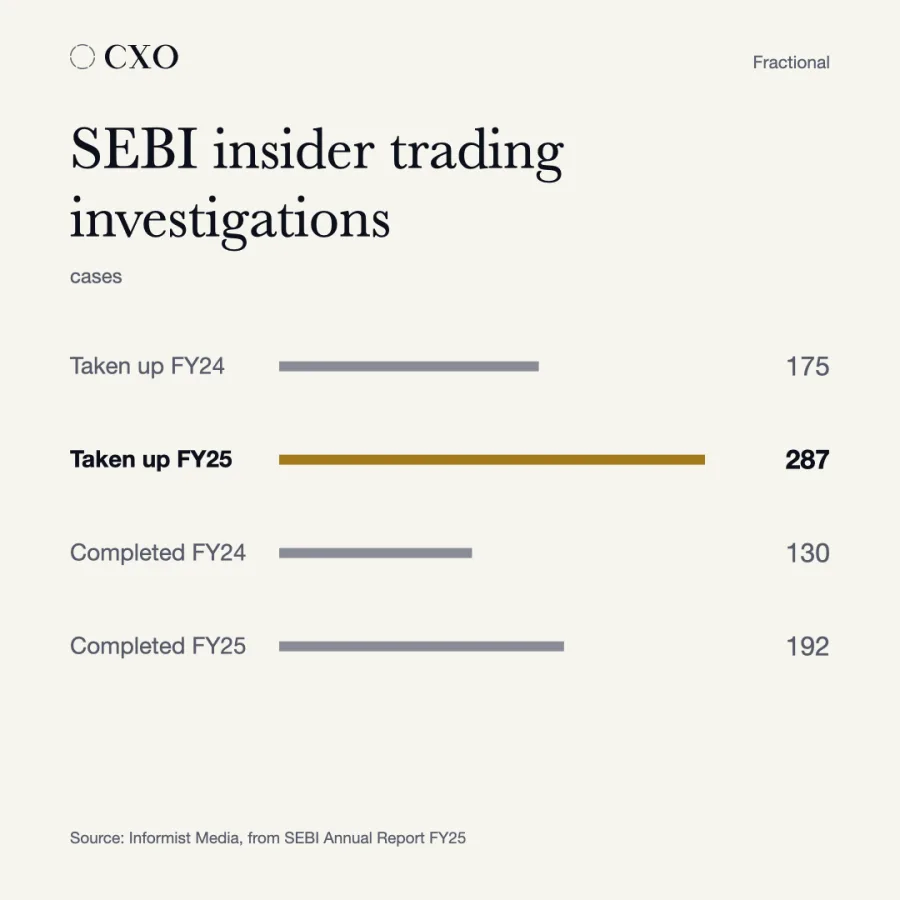
SEBI's annual report for 2025-26 (Table 10.4) shows 221 insider trading investigations taken up, down from 287 the year before, and 202 completed, up from 192. The figures do not show how many cases involved consultants or advisers.
The UK reaches the adviser through paperwork. Article 18 of UK MAR requires issuers and anyone acting on their behalf or on their account to keep an insider list for at least five years, and each person on it acknowledges the duties in writing. legislation.gov.uk lists its revocation under the Financial Services and Markets Act 2023 as not yet applied, with no date shown. India reaches the adviser through the definition. The UK habit is worth copying while it lasts, because a written acknowledgement for each information event gives the fractional leader a dated record of what they knew and when. Someone with two listed clients faces overlapping board cycles, and the six month tail adds half a year to each mandate.
We would take the mandate and write the barrier into the engagement letter on day one: ask whether the client's code will name you a designated person, so its compliance officer's pre-clearance covers your trades, and agree a written trading restriction if it will not, since regulation 9(4) lists employees and support staff and is silent on outside advisers. Keep a log of each time price sensitive information arrives and record the date the engagement ends, because the six months run from the end of the association. Do not trade the client's shares until six months after that date, or until what you know is public if that comes later. That slows the personal portfolio. We accept the cost because a record kept from the first board meeting is far easier to rely on than one reconstructed after a SEBI notice.
This is based on our research into public sources and is not legal advice. Check how it applies to your company with your lawyers and advisers.
Sources (5)
- TaxGuru, SEBI (Prohibition of Insider Trading) (Third Amendment) Regulations 2024 (4 December 2024)
- SEBI, Annual Report 2025-26, Chapter 10, Table 10.4 Trends of Investigations (August 2026)
- legislation.gov.uk, UK MAR Article 18, insider lists (revised text current to 11 November 2026)
- SEBI (Prohibition of Insider Trading) Regulations 2015, amended up to 12 Mar 2025, regs 2(1)(d), 9(4)
- India Code, Companies Act 2013 (consolidated PDF), section 203