

A fractional CMO or CHRO about to take a second client in the same sector has one clause to read first: what the current retainer says about working for others while it runs. Indian courts have treated restraints that apply after a contract ends very differently from restraints that apply during it.
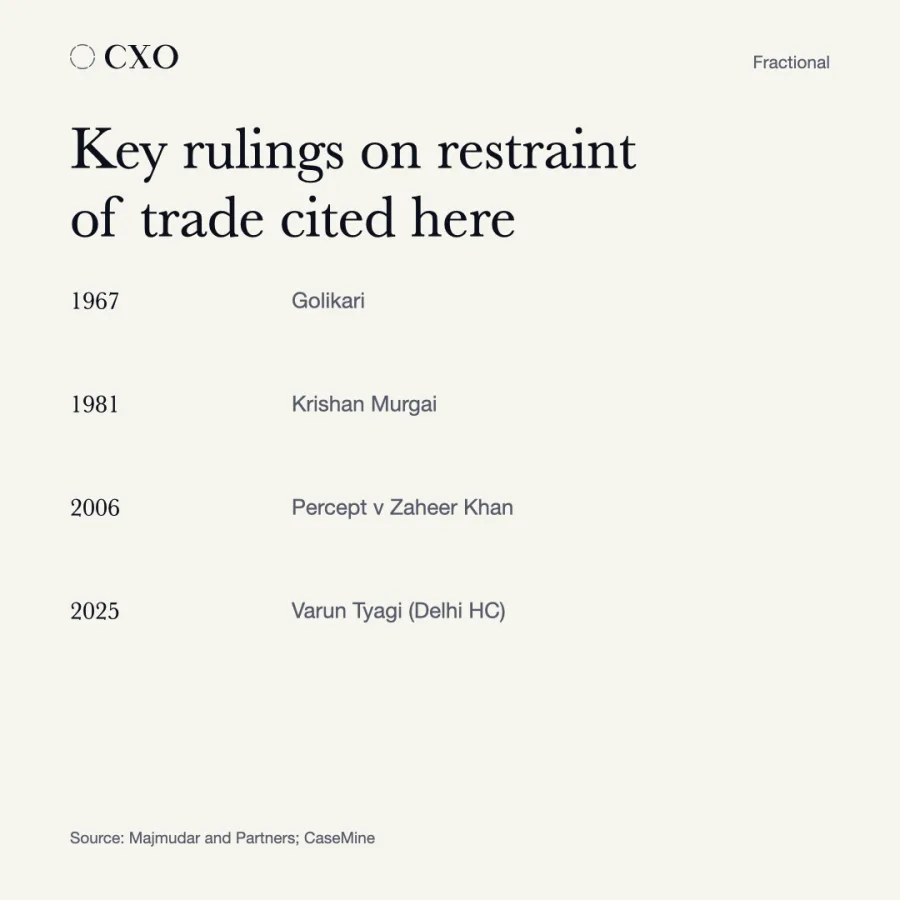
After exit, section 27 of the Contract Act makes void "every agreement by which any one is restrained from exercising a lawful profession, trade or business of any kind", with one exception for a sale of goodwill. In Percept D'Mark v Zaheer Khan (22 March 2006), the Supreme Court found prima facie that a right of first refusal in a cricketer's management agreement became void "the moment it is sought to be enforced beyond the term", and called that reading of section 27 uniform since 1874. In Varun Tyagi v Daffodil Software in June 2025, the Delhi High Court set aside an interim injunction resting on a clause that barred an engineer from working with his employer's "business associate" for three years after he left, Majmudar and Partners reports. Both rulings came at the interim stage.
During the term, the Supreme Court said in Golikari (1967) that negative covenants operating while an employee is bound to serve the employer exclusively "are generally not regarded as restraint of trade", unless the contract is "unconscionable or excessively harsh or unreasonable or one sided". In Superintendence v Krishan Murgai (1980), Justice A.P. Sen, in a concurring judgment, said the doctrine "never applied during the continuance of a contract of employment; it applies only when the contract comes to an end".
In Gujarat Bottling v Coca-Cola (4 August 1995), the Supreme Court applied that line to a commercial agreement. It upheld, at the interim injunction stage, a bottler's promise not to deal in other brands' beverages while the agreement subsisted, including a one-year notice period, and said it found "no rational basis for confining this principle to a contract for employment". The same judgment says a court need not grant an injunction in every case and will refuse one that would indirectly force an employee into idleness or into serving the employer. We found no reported case on a fractional executive's retainer. Whether a court would treat a retainer like the franchise in Gujarat Bottling, and how it would treat an exclusivity period that runs past the end of a retainer, are open questions.
Before signing the second client, send counsel the exclusivity, termination and notice clauses of the first retainer with three questions: does any restriction run past the end of the retainer, and for how long; does the definition of competitor cover the new client; and could the restriction be read as one sided, given what the client pays and how either side can end the engagement. Ask the first client in writing whether it regards the new client as a competitor, keep the answer on file, and agree a notice process for any later conflict while both sides still want the engagement.
This is based on our research into public sources and is not legal advice. Check how it applies to your company with your lawyers and advisers.
Sources (7)
- Majmudar and Partners, Delhi High Court holds non-compete clause unenforceable
- CaseMine column, Negative Covenants and Injunctions in Indian Contract Law
- CaseMine column, Section 27 of the Indian Contract Act, 1872: Contemporary Perspectives on Restraint of Trade
- Tatva Legal on Legal 500, Landmark judgement analysis: Gujarat Bottling Company Limited and others v Coca Cola Company and others, 31 May 2021
- Supreme Court of India, Gujarat Bottling Co. Ltd. v The Coca Cola Co., 4 August 1995, 1995 SCC (5) 545 (JUDIS text reproduced by Legal Authority)
- Supreme Court of India, Percept D'Mark (India) Pvt. Ltd. v Zaheer Khan, 22 March 2006, (2006) 4 SCC 227 (JUDIS text reproduced by Legal Authority)
- Verdictum, Varun Tyagi v Daffodil Software Pvt. Ltd., neutral citation 2025:DHC:5015