

A former CFO taking fractional work for a private company, and the founder drafting the retainer, have to decide how the engagement papers describe who runs the books and the filings. No law requires that company to have a CFO, yet the Companies Act attaches liability to whoever the board charges with the accounts.
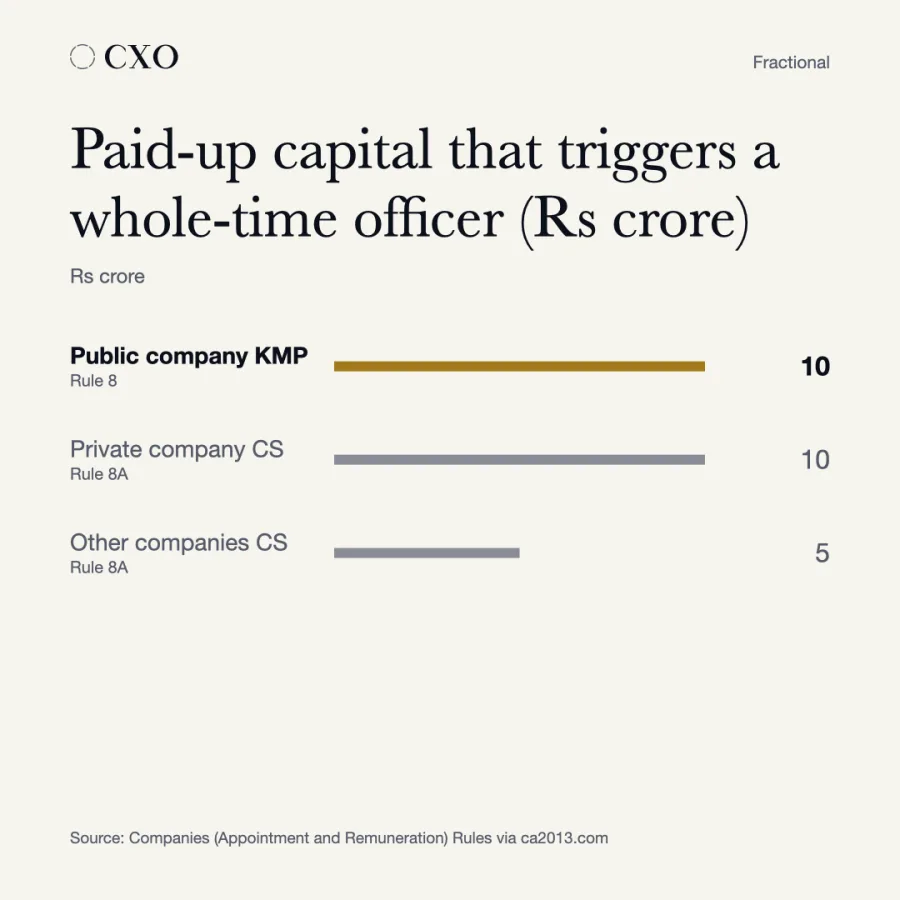
Rule 8 under section 203, as reproduced on ca2013.com, requires whole-time key managerial personnel, including a CFO, only in listed companies and in public companies with paid-up capital of ten crore rupees or more. Rule 8A asks private companies of that size for a whole-time company secretary, and not for a CFO.
Liability comes in through two other sections. Section 128(6), in the Act on India Code, reaches the managing director, the whole-time director in charge of finance, the CFO "or any other person of a company charged by the Board with the duty of complying with the provisions of this section", and sets a fine of fifty thousand to five lakh rupees. Section 2(60), which lists "officers of a company" who are in default, covers in clause (iv) any person who, "under the immediate authority of the Board or any key managerial personnel", is charged with responsibility including "maintenance, filing or distribution of accounts or records" and who "authorises, actively participates in, knowingly permits, or knowingly fails to take active steps to prevent" a default.
Three points are untested. The first is whether a retained adviser is "such other person of the company" under section 128(6). The second is whether a fractional CFO is an officer at all, since section 2(59) defines officer as including directors, managers, key managerial personnel and persons whose directions the board is accustomed to follow. The third is whether clause (iv) needs written consent: clause (iii) asks for a director's consent in writing and clause (iv) does not, and commentators differ. We found no order applying either section to a fractional CFO, and no Indian D&O wording that settles cover.
Small defaults count. Cyril Amarchand Mangaldas wrote on 15 October 2024, citing Registrar of Companies orders of 9 August 2024, that officers were being penalised "for both mundane and technical non-compliances, such as incorrect pagination".
Section 1121 of the UK's Companies Act 2006 treats a director, manager or secretary as in default if he "authorises or permits, participates in, or fails to take all reasonable steps to prevent" the contravention. India's clause (iv) reaches anyone charged with the accounts, a wider group, and adds "knowingly" to the permitting and failing limbs.
For FY27 close engagements being signed now, put three questions to the company's counsel and file the answers with the engagement letter: whether the retainer or any board note charges the adviser with the books or filings, and if so whether the adviser consents in writing; which named company officer signs and files; and whether the D&O insurer confirms in writing that a retained adviser is an insured person.
This is based on our research into public sources and is not legal advice. Check how it applies to your company with your lawyers and advisers.
Sources (6)
- ca2013.com, Companies Act 2013 section 203 with Rules 8 and 8A (valid as on 6 Nov 2026)
- ca2013.com, Companies Act 2013 section 128 (valid as on 6 Nov 2026)
- TaxGuru, Definition of officer who is in default under Companies Act 2013 (24 Jul 2023)
- Cyril Amarchand Mangaldas, Critiquing the regulatory threshold for an officer who is in default (15 Oct 2024)
- legislation.gov.uk, Companies Act 2006 section 1121 (accessed Nov 2026)
- India Code, Companies Act 2013 (consolidated PDF), sections 2(59), 2(60), 128(6), 203