
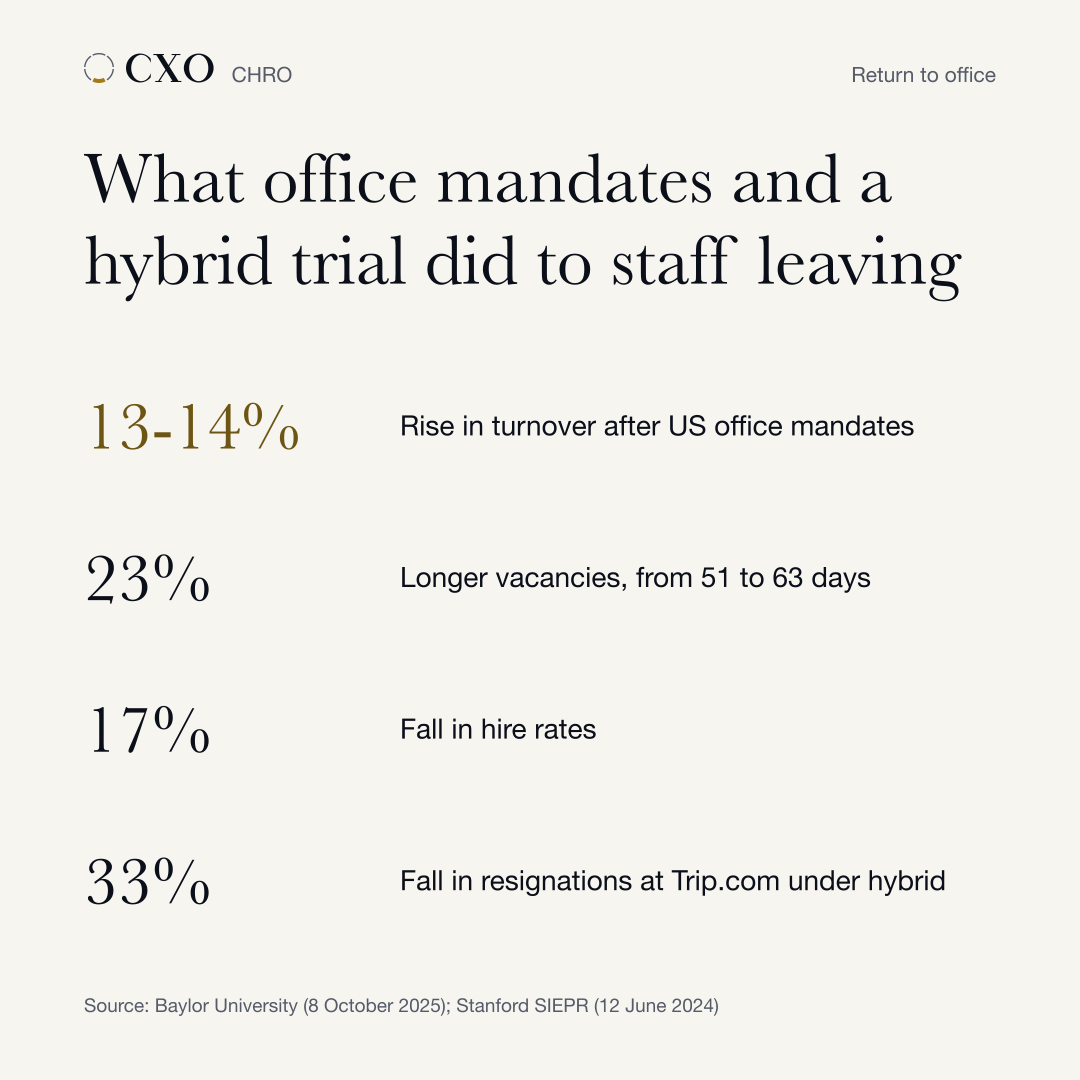
A CHRO under pressure to bring staff back five days a week has to decide how many office days to require and whether to tie pay to attendance. On attrition, two recent studies point the same way. Yuye Ding, Mark Ma and co-authors studied 54 large S&P 500 technology and financial firms that adopted office mandates between 2020 and 2023, using more than three million worker profiles from Revelio Labs. Turnover rose by an average 13-14% after the announcements, Baylor University reported on 8 October 2025. Women's turnover rose nearly three times as much as men's, and mid and senior managers and high-skilled staff left at higher rates.
Replacing them took longer. Vacancy duration rose 23%, from 51 to 63 days on average, and hire rates fell 17%. Placebo tests using false mandate dates showed no effect.
The randomised evidence comes from China. Nicholas Bloom, Ruobing Han and James Liang assigned more than 1,600 Trip.com staff either to five office days or to three, in a six-month experiment from 2021, and followed performance and promotion for up to two years. Resignations fell 33% among those moved to hybrid, with no effect on productivity or promotion, Stanford's SIEPR reported. The fall in resignations came among non-managers, and was largest for women and long commuters. Managers had expected productivity to suffer and changed their view by the end.
Indian IT has chosen attendance rules. TCS linked quarterly variable pay to office attendance in 2024, paying nothing below 60% attendance and the full amount above 85%, India Infoline reported. Infosys introduced system checks from 10 March 2025 to enforce ten office days a month for job level 5 and below, Storyboard18 reported, citing The Economic Times.
Neither study is Indian, and we found no Indian employer that has published attrition split by attendance policy. Our judgment is that the losses in the US data would fall hardest here on the same groups, women in mid-level roles and senior specialists, who are also the hardest to replace.
We would set three office days for teams that need them, keep variable pay tied to results, and measure resignations by grade and gender for two quarters before and after any change. A five-day rule should wait until that data exists.
Sources (4)
- Baylor University Hankamer School of Business, Return-to-office mandates and the hidden cost of brain drain (8 October 2025)
- Stanford SIEPR, Hybrid work is a 'win-win-win' for companies and workers, study finds (12 June 2024)
- India Infoline, TCS implements in-office work policy for variable pay distribution (23 April 2024)
- Storyboard18, citing The Economic Times, Infosys implements 'system intervention' to ensure 10-day office attendance (6 March 2025)