
A manufacturer buying renewable power through a group captive plant has to decide how large a stake to take. The Electricity (Amendment) Rules, 2026, notified on 13 March 2026 as G.S.R. 186(E), rewrote the captive rule. Captive users must still hold at least 26% of the plant together and consume at least 51% of its output in the year, and the rules now test both conditions across all users together. From 1 April 2026 each user's captive consumption counts only up to 100% of its share of ownership, and a user that holds 26% or more is exempt from that cap.
Groups gain room too. A captive user, its subsidiaries, its holding company and that company's other subsidiaries count as one user, and power drawn through a storage system charged by the plant counts as captive, Saraf and Partners notes. Every SPV is treated as an association of persons. A state nodal agency verifies plants whose users sit in the same state, and the National Load Despatch Centre verifies inter-state plants. Khaitan & Co reads the rules as holding off cross-subsidy surcharge and additional surcharge while verification is pending, if the user files a declaration, with the charges due plus carrying cost if the plant fails.
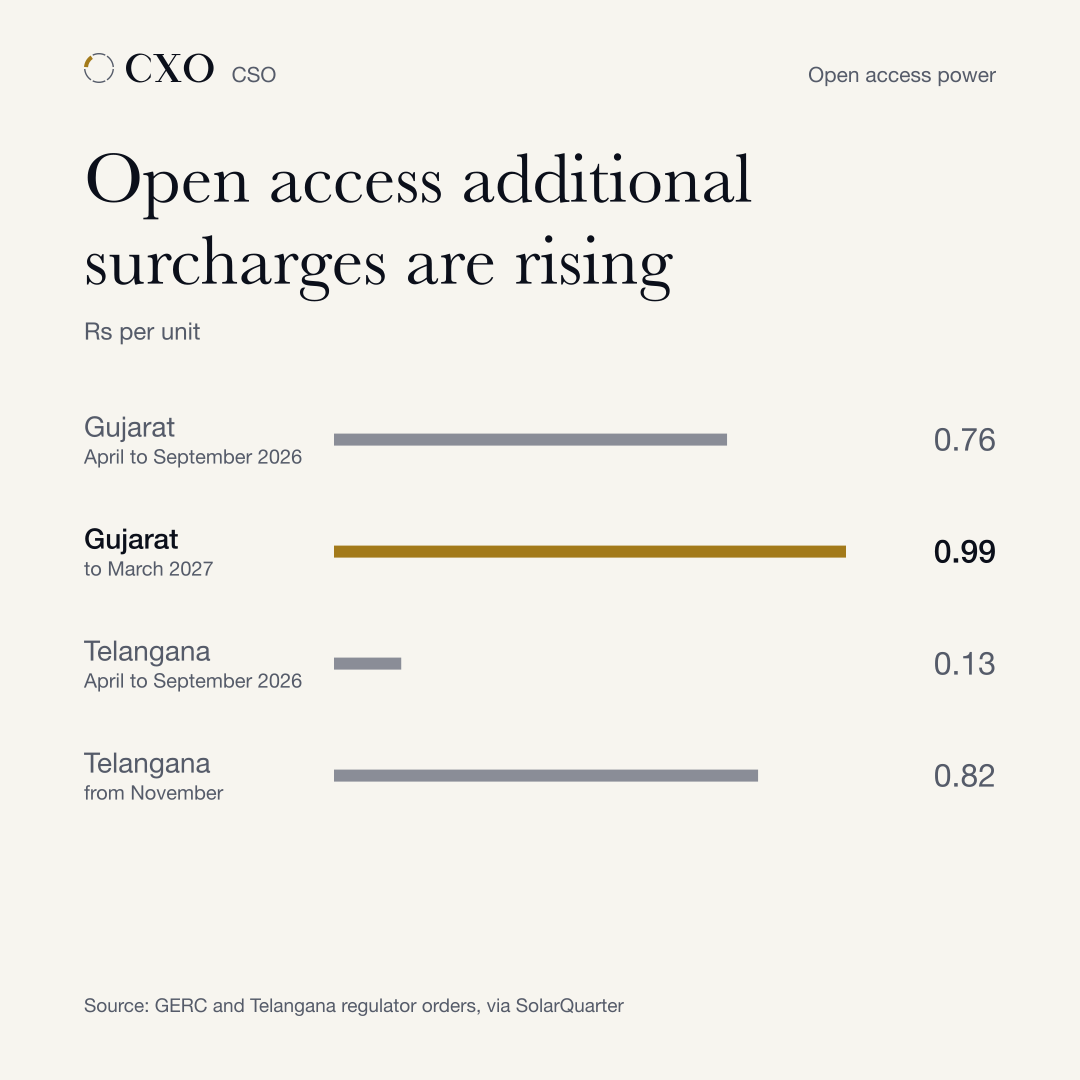
Those charges are rising for buyers outside captive status. Gujarat's regulator set the additional surcharge at Rs 0.76 a unit for April to September 2026 and Rs 0.99 for October 2026 to March 2027. Telangana's went from Rs 0.13 to Rs 0.82 a unit from November, SolarQuarter reports of the two orders.
Round-the-clock supply is where the storage clause matters. LevelTen Energy's index for the second quarter of 2026 found solar-plus-storage PPAs in Europe priced 24% above solar-only contracts, and hybrid offers outnumbered every other contract type in Spain and Germany that quarter.
Our judgment is that a single anchor holding 26% becomes the standard group captive structure, because it removes that buyer's exposure to how the other users consume. We also expect surcharges to keep rising, and we are wrong if Gujarat or Telangana sets its rate for April to September 2027 below its current level.
If your plants would use most of the output, we would hold 26% in one group company and draw the group's load through it. With a smaller stake, size it to your actual load profile, and write into the SPV agreement who bears surcharges and carrying cost if another user's consumption makes the plant fail verification.
This is based on our research into public sources and is not legal advice. Check how it applies to your company with your lawyers and advisers.
Sources (7)
- Saraf and Partners, Electricity Amendment Rules 2026: Preliminary Observations (March 2026)
- Khaitan & Co, ERGO: Electricity (Amendment) Rules, 2026 (20 March 2026)
- SolarQuarter, GERC fixes Rs 0.76/kWh additional surcharge for April-September 2026 (19 March 2026)
- SolarQuarter, GERC sets Rs 0.99/kWh additional surcharge from October 2026 (16 September 2026)
- SolarQuarter, Telangana regulator approves Rs 0.13/kWh additional surcharge for H1 FY27 (11 March 2026)
- SolarQuarter, Telangana approves Rs 0.82/kWh additional surcharge for November 2026 to March 2027 (3 November 2026)
- ESS News, Battery-backed PPAs gain ground in Europe despite 24% premium (24 July 2026, on LevelTen Energy's Q2 2026 index)