
A manufacturer building a solar plant for its own use through open access or net metering has to decide whether to pay to finish it before 31 December 2026. MNRE's office memorandum of 9 December 2024 said such projects commissioned on or after 1 June 2026 must use modules from ALMM List-I made with cells from ALMM List-II, the approved list of Indian cell makers. A memorandum of 18 July 2026, as pv-tech and Energetica India report it, extended the exemption for net-metering and open access projects to 31 December 2026, with List-II cells mandatory from 1 January 2027. MNRE called it a limited relaxation and refused a blanket extension.
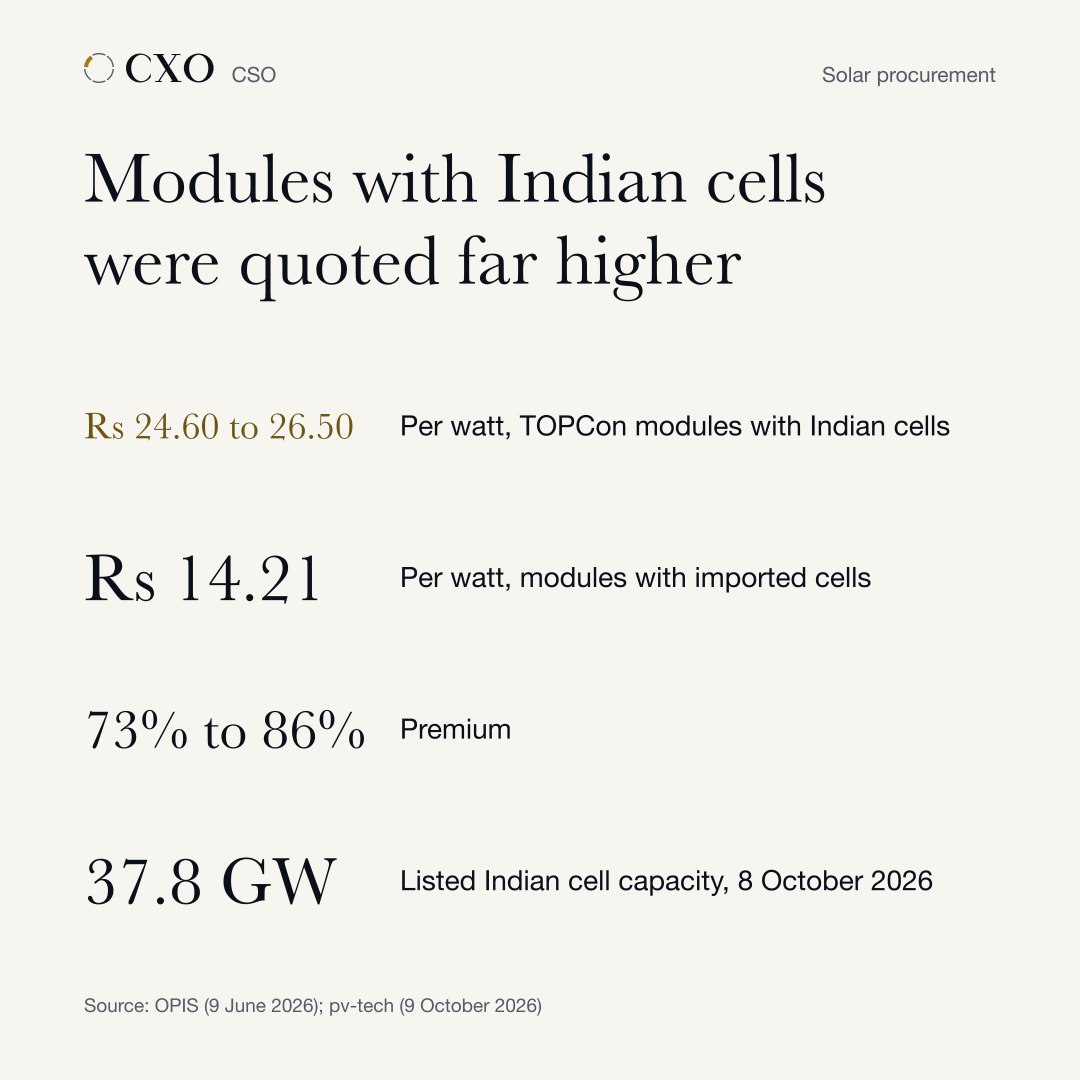
The gap is in cells. The 12th revision of List-II on 8 October 2026 brought listed cell capacity to 37.8 GW, pv-tech reports, while Energetica India counted 228.5 GW of listed module capacity after the September update. OPIS reported in June 2026 limited ex-factory indications of Rs 24.60 to 26.50 per watt for TOPCon modules with Indian cells, against Rs 14.21 for modules with imported cells, a premium of 73% to 86%. MNRE has asked makers to report monthly price ranges to NISE and warned against 'excessive opportunistic profiteering'. CareEdge estimated in December 2024 that the cell rule could raise solar tariffs by 40 to 50 paise a unit until Indian cell supply grows.
The next step is already set. MNRE will extend the list to wafers and ingots from 1 June 2028, covering net-metering and open access projects, once at least three independent wafer plants with 15 GW combined are running.
The EU has chosen a narrower tool. Under the Net-Zero Industry Act, member states must apply non-price criteria to at least 30% of the renewable capacity they auction each year, or 6 GW, from 30 December 2025, and a resilience test applies only where one non-EU country supplies more than half of EU demand, Covington's summary of the implementing act explains. India applies its rule to every covered project.
Our judgment is that MNRE holds the 1 January 2027 date for open access, having already refused a general extension. We are wrong if it grants another general extension for open access projects before the end of December.
For a plant due in the first quarter of 2027, we would price the cost of finishing early against the module premium on the full capacity, and write the cell source, the List-II supplier and a price-adjustment clause into the EPC contract now.
This is based on our research into public sources and is not legal advice. Check how it applies to your company with your lawyers and advisers.
Sources (9)
- MNRE, Office Memorandum No. 283/34/2026-GRID SOLAR on ALMM List-II (6 July 2026), reciting OM of 9 December 2024
- pv-tech, MNRE extends ALMM List-II exemption for net-metering and open access solar projects (20 July 2026)
- Energetica India, MNRE extends ALMM List-II exemption for net metering, open access projects till Dec 2026 (18 July 2026)
- pv-tech, India's MNRE issues 12th solar cell ALMM revision, capacity reaches 37.8GW (9 October 2026)
- Energetica India, ALMM update: solar module capacity surpasses 228 GW in September 2026
- OPIS, MNRE seeks to monitor solar cell, module prices as domestic cell mandate takes effect (9 June 2026)
- Energetica India, ALMM on solar cells may push tariffs by 40-50 paise per unit: CareEdge Ratings (20 December 2024)
- Energetica India, MNRE extends ALMM to solar wafers and ingots, to be effective from June 1, 2028 (18 March 2026)
- Covington, Global Policy Watch: Adoption of implementing act on non-price criteria in renewable energy auctions (August 2025)