
A CHRO planning the April 2027 increment cycle has to decide whether to redesign pay so that allowances stay within half of remuneration, or accept a larger wage base for gratuity and other benefits. The Code on Wages uses one definition of wages, and where excluded items such as house rent and conveyance allowance exceed 50% of total remuneration, the excess is added back to wages, King Stubb & Kasiva explains.
The Labour Ministry's FAQs of 16 March 2026, as summarised by SCC Online, say the revised definition took effect on 21 November 2025, that overtime allowance counts toward the 50% test, and that gratuity, ESI and other retirement benefits sit outside total remuneration for this purpose. Gratuity for service before 21 November 2025 falls under the Payment of Gratuity Act, 1972, but the wage last drawn at exit, under the new definition, sets the amount for the entire period.
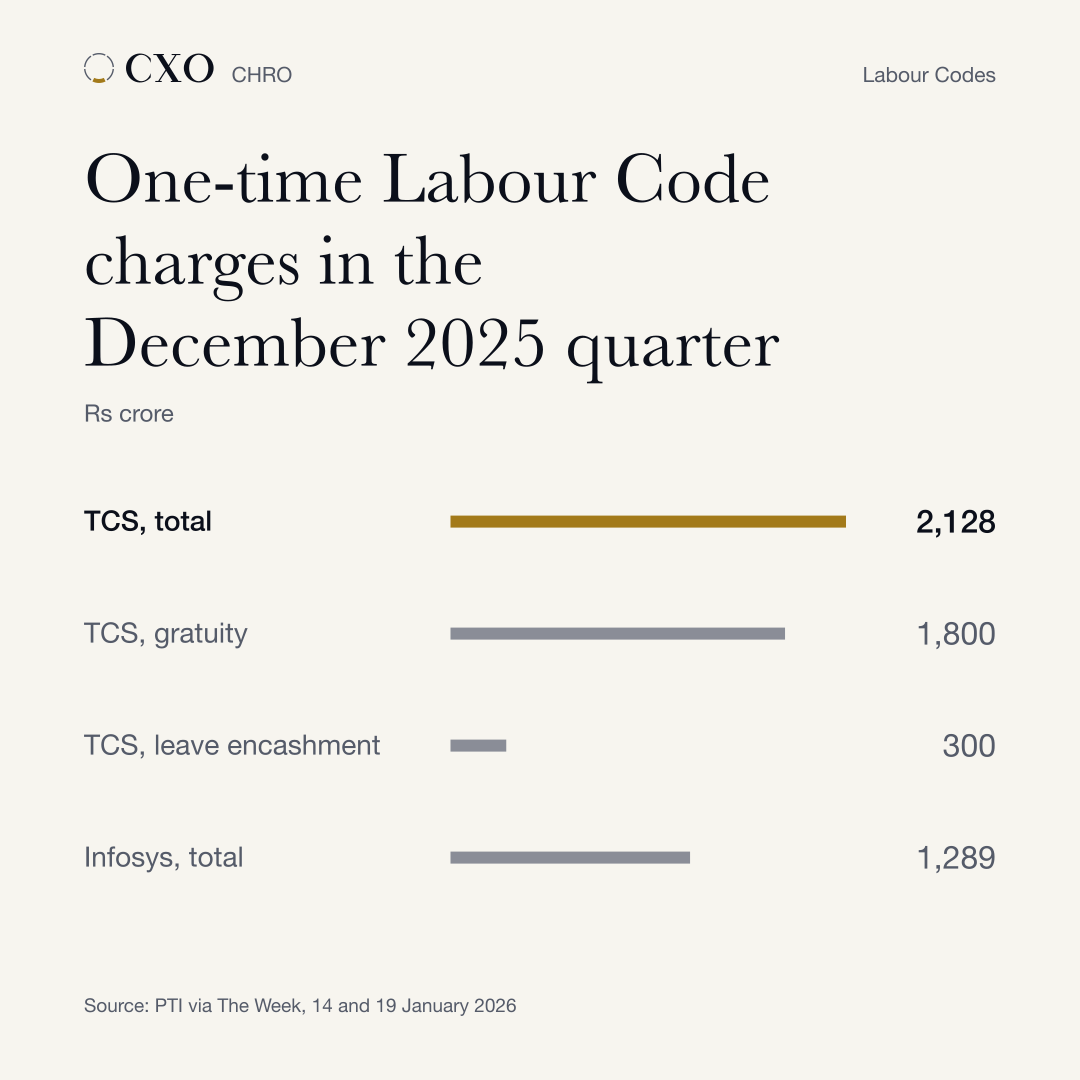
That last point is why large employers took one-time charges. PTI reported that TCS recorded a statutory impact of Rs 2,128 crore in the December 2025 quarter, about Rs 1,800 crore of it for gratuity and Rs 300 crore for leave encashment, and that Infosys took an exceptional charge of Rs 1,289 crore for higher gratuity liability from past service cost and higher leave liability. Infosys's management put the continuing margin effect at about 15 basis points a year, and TCS's CFO at 0.10 to 0.15 per cent.
The United Kingdom handles a similar question with a cap. Statutory redundancy pay counts a week's pay only up to GBP 751 from 6 April 2026, under the Employment Rights (Increase of Limits) Order 2026, so how pay is split above that line does not change the statutory payment. India's rule works from the other side, setting a floor under what counts as wages, which exposes every grade paid mostly in allowances.
Our judgment is that the cost will show up again in the 2027 cycle. An increment paid as allowance in a grade already over the line raises the gratuity base for every past year of service, because gratuity is computed on the last wage drawn.
We would run the 50% test on every grade and band, with overtime included, before the increment budget is fixed, and route increments for grades near the line into basic pay. Ask the actuary to show the gratuity charge under both designs before the board approves the cycle.
This is based on our research into public sources and is not legal advice. Check how it applies to your company with your lawyers and advisers.
Sources (5)
- King Stubb & Kasiva, 50% wage rule under India's new Labour Codes: impact on salary, PF and gratuity (updated 14 October 2026)
- SCC Online, Ministry FAQs on the four Labour Codes (26 April 2026)
- The Week (PTI), Q3 earnings: major IT cos take cumulative hit of Rs 5,400 cr from new labour code implementation (19 January 2026)
- The Week (PTI), After TCS, Infosys sees one-time hit from new labour codes in Q3 (14 January 2026)
- legislation.gov.uk, The Employment Rights (Increase of Limits) Order 2026, SI 2026/310