
A CISO at an Indian commercial bank who still reports to the Head of IT has to move that line now. The Reserve Bank of India's Commercial Banks Cybersecurity, Technology: Risk, Resilience and Assurance Framework Directions, dated 31 July 2026, took effect on issue. They say the CISO has no direct reporting relationship with the Head of IT, reports to the executive overseeing risk management, carries no business targets and places a review of cyber risk and preparedness before the Board, its risk committee or the IT Strategy Committee at least quarterly.
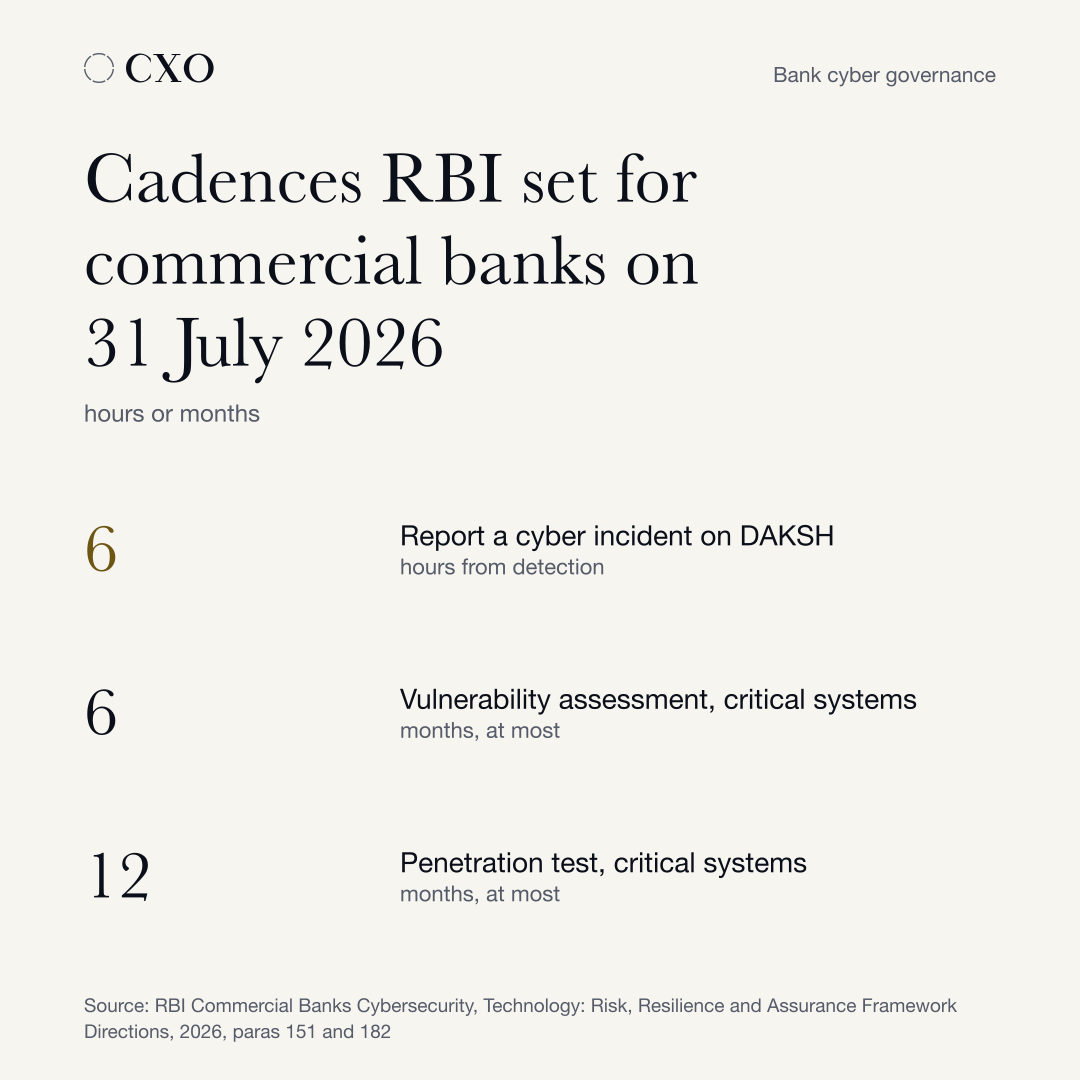
The same directions fix the testing and reporting cadence. Cyber incidents go to RBI's DAKSH platform within 6 hours of detection, and CERT-In must also be notified. Critical systems, and customer-facing systems in the demilitarised zone, need a vulnerability assessment at least once in every 6 months and a penetration test at least once in 12 months. Disaster recovery drills for critical systems run at least half-yearly. The Data Security Council of India's brief notes that the directions came without the transition windows of earlier circulars and expect banks to run the recovery site as the primary site for a full business day.
RBI issued Digital Payment Security Controls Directions the same day for each type of bank and for NBFCs. KPMG notes they reach non-financial transactions such as balance enquiry, PIN changes and one-time password generation. The payments bank version requires a board-approved digital payment policy reviewed at least annually, retirement of old mobile app versions within six months of a newer release, and reconciliation of settlement files within 24 hours. On 5 November 2026 RBI consolidated cyber resilience and payment security directions for non-bank payment system operators; as reported by Vinod Kothari and Company, large and medium operators comply from publication, small ones by 1 April 2028, and audit logs must be kept for at least five years.
Quantum risk is the next item on the list. On 25 May 2026 RBI set up Q-SAFE, an eight-member expert committee convened by Professor Anil Prabhakar of IIT Madras. Its terms include mapping the financial sector's cryptographic assets through a Cryptography Bill of Materials, identifying the most exposed critical systems and proposing a roadmap. Its report is due within six months of its first meeting.
Our judgment is that the reporting line will be the hardest change, because it moves budget authority and escalation away from technology. We would also start the cryptographic inventory now, so it is ready when Q-SAFE reports. We are wrong if RBI's supervisory findings for 2026-27 point mainly to testing or incident-reporting lapses and leave CISO independence unmentioned.
For the next board cycle we would put three items on the paper: the new reporting line with the CISO's minimum term, a tested end-to-end workflow for the DAKSH filing, and the list of technology vendor contracts that still lack RBI audit rights.
This is based on our research into public sources and is not legal advice. Check how it applies to your company with your lawyers and advisers.
Sources (6)
- Reserve Bank of India, (Commercial Banks - Cybersecurity, Technology: Risk, Resilience and Assurance Framework) Directions, 2026 (31 July 2026, updated 1 October 2026)
- Reserve Bank of India, (Payments Banks - Digital Payment Security Controls) Directions, 2026 (31 July 2026)
- Reserve Bank of India, press release on the Q-SAFE expert committee (25 May 2026)
- KPMG in India, RBI's technology-focused Master Directions issued on 31 July 2026 (September 2026)
- Data Security Council of India, Brief on RBI Cybersecurity Directions (Commercial Banks), 2026
- Vinod Kothari and Company, RBI's consolidated Master Directions on cyber resilience and digital payment security controls for non-bank PSOs (November 2026)