
A listed company ranked between 501 and 1,000 by market value has to choose, for its first verified BRSR Core report, between a third-party assessment and an assurance engagement.
A listed company ranked between 501 and 1,000 by market value has to choose, for its first verified BRSR Core report, between a third-party assessment and an assurance engagement. SEBI's circular of 28 March 2025 made assessment or assurance of BRSR Core mandatory for the top 1,000 listed entities from FY 2026-27, the year that began on 1 April. It defines assessment as a third-party review under standards developed by the Industry Standards Forum in consultation with SEBI.
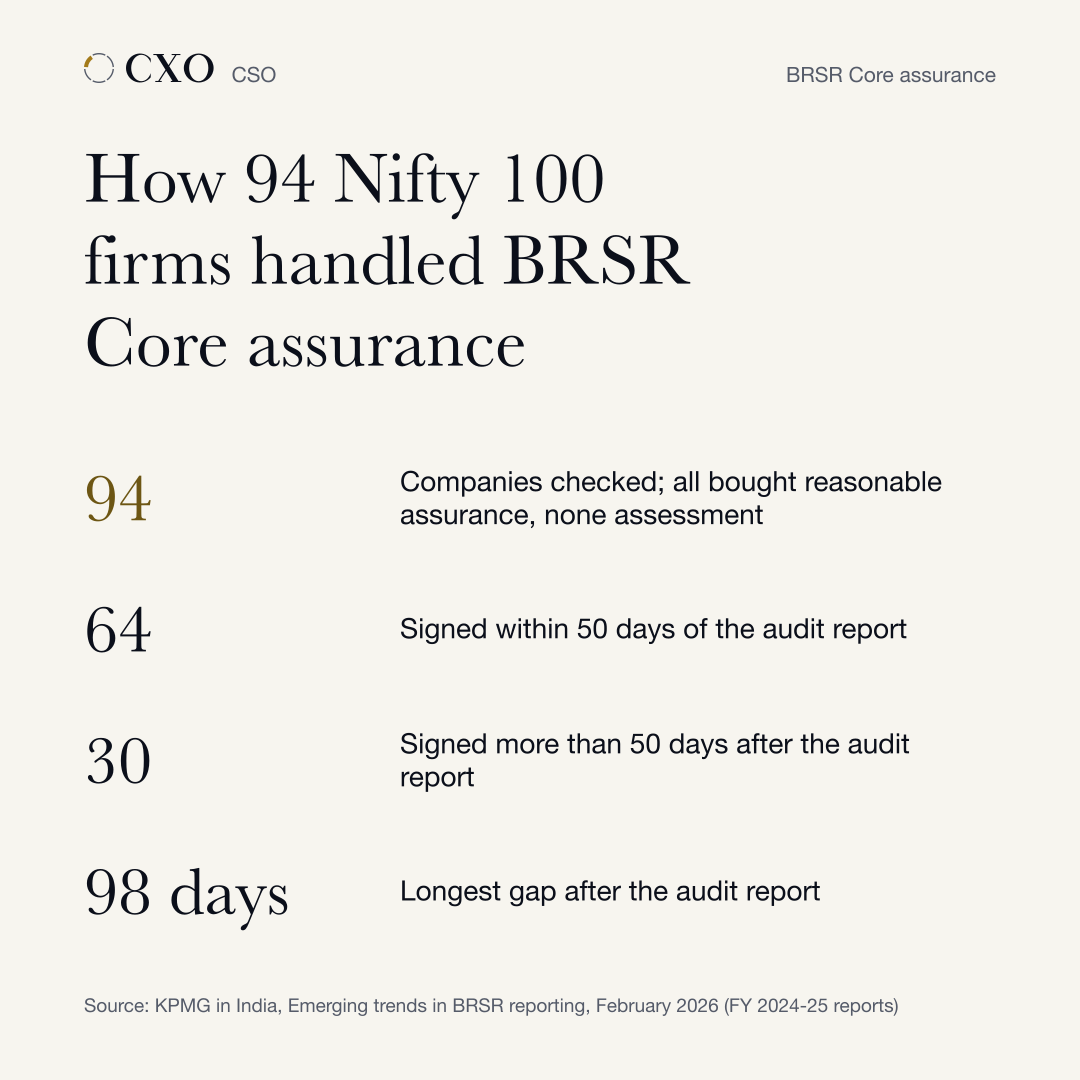
The largest companies have already chosen. KPMG read the FY 2024-25 annual reports of 94 Nifty 100 companies and found that all of them obtained reasonable assurance and none used the assessment option. One construction company received a qualified opinion because evidence for some BRSR Core figures was missing. Timing was the larger strain: 30 of the 94 signed their BRSR assurance report more than 50 days after the audit report on their accounts, the longest 98 days after, and 14 signed on or before the audit report date.
The same circular limits who can do the work. The board must be satisfied that the provider has the expertise, and the provider and its associates may not sell products or provide non-audit services, consulting included, to the company or its group. On that wording, a firm that sells you ESG consulting should not also assess or assure your BRSR Core.
Abroad, the floor is lower. Accountancy Europe's reading of the EU Omnibus I Directive is that limited assurance stays mandatory for companies left in CSRD scope, with an EU limited assurance standard due by 1 July 2027. Japan's Financial Services Agency will require assurance one year after its SSBJ standards become mandatory, limited to specific information for the first two years. The IAASB's ISSA 5000 applies to assurance of periods beginning on or after 15 December 2026, which for a March year-end means FY 2027-28.
Our judgment is that most of the newly covered companies will follow the top 100 and buy assurance, because lenders and investors already compare them with the largest companies, which all show an assurance opinion. We are wrong if more than a quarter of the companies ranked 501 to 1,000 file their FY 2026-27 BRSR with an assessment in place of assurance.
We would appoint the provider this quarter, choosing one with no consulting role in your ESG data, and have it test the April to September numbers before 31 March 2027. That gives the plant teams time to fix gaps before year-end, and 64 of the 94 Nifty 100 companies managed to sign within 50 days of the audit report.
This is based on our research into public sources and is not legal advice. Check how it applies to your company with your lawyers and advisers.
Sources
- SEBI, Circular SEBI/HO/CFD/CFD-PoD-1/P/CIR/2025/42 on assurance or assessment, value chain and green credits (28 March 2025)
- KPMG in India, Accounting and Auditing Update, Emerging trends in BRSR reporting by listed companies (February 2026)
- Accountancy Europe, Omnibus explained: key changes to the CSRD (January 2026)
- Financial Services Agency of Japan, Japanese Roadmap on Sustainability Disclosure and Assurance (2026)
- IAASB, Understanding International Standard on Sustainability Assurance 5000