

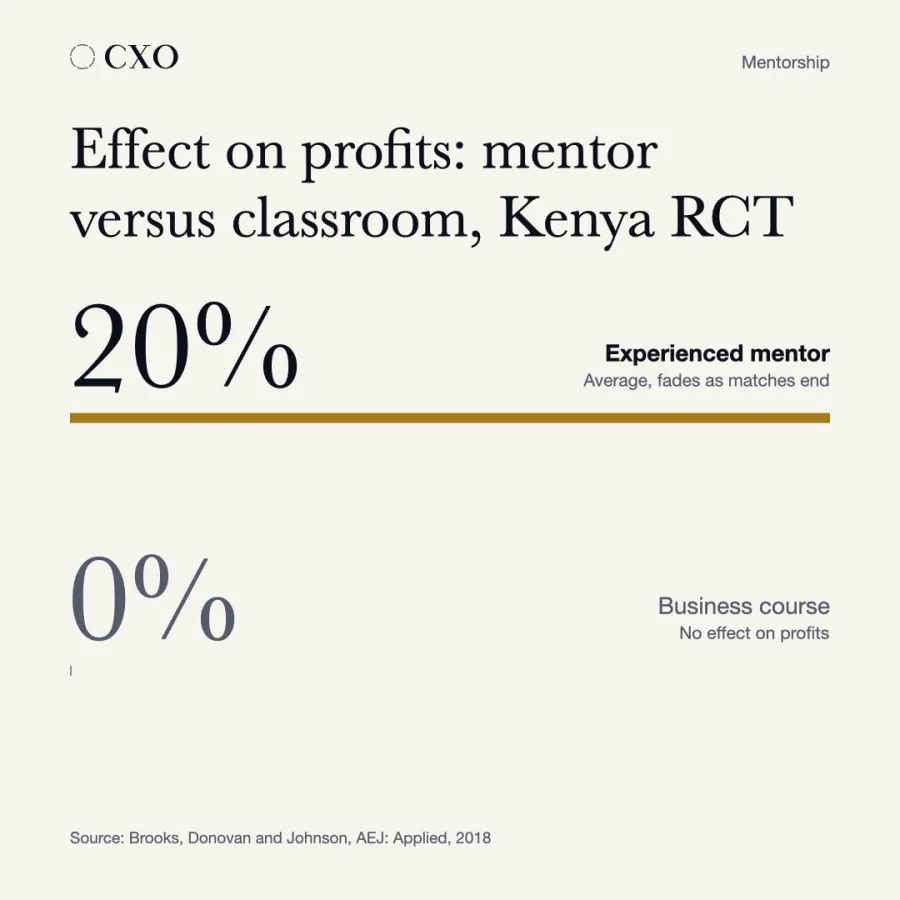
A CHRO setting the FY27 development budget can move money from a classroom leadership programme into mentoring pairs, and the clearest trial we found says to fund fewer pairs for longer.
Brooks, Donovan and Johnson, in the American Economic Journal: Applied Economics in October 2018, randomly assigned Kenyan entrepreneurs to mentoring by an experienced local entrepreneur or to a formal business course. Mentoring raised profits by 20% on average, with the effect largest early on and fading as the matches ended. The course changed business practices and had no effect on profits. The authors conclude that localised, specific knowledge from a mentor helped and general classroom material did not.
The participants were inexperienced women running microenterprises in a slum, and nothing shows an effect of that size carries over to executives. We use it for the pattern: the benefit came from knowledge specific to the mentee's market and lasted only as long as the pairing.
A second study bears on who gains least from advice. In NBER Working Paper 24789 of July 2018, a randomised trial with 100 high-growth technology firms in India, Chatterji, Delecourt, Hasan and Koning found that entrepreneurs with MBAs or accelerator experience did not respond to their peer advice intervention, and the authors suggest formal training can limit how far peer advice spreads. Our reading is that a trained executive will discount a mentor who repeats the classroom, so the match has to rest on knowledge the mentee lacks.
Retention pressure is one reason to revisit the budget. Deloitte India said on 30 March 2026 that median CFO pay in India is INR 4.5 crore and that CFOs had the largest pay increase among CXOs, which it linked in part to high attrition. We found no Indian randomised study of corporate executive mentoring, and no comparison from a major market or named company that we could verify.
We would cut the number of pairs and fund each one through the whole of the mentee's next hard stretch, such as a first year in a new role, since in the Kenyan trial the gains faded as the matches ended. The money would come from classroom modules, because the course in that trial moved practices and left profit where it was. Each match would be approved only once someone can name what the mentor knows that the mentee does not.