
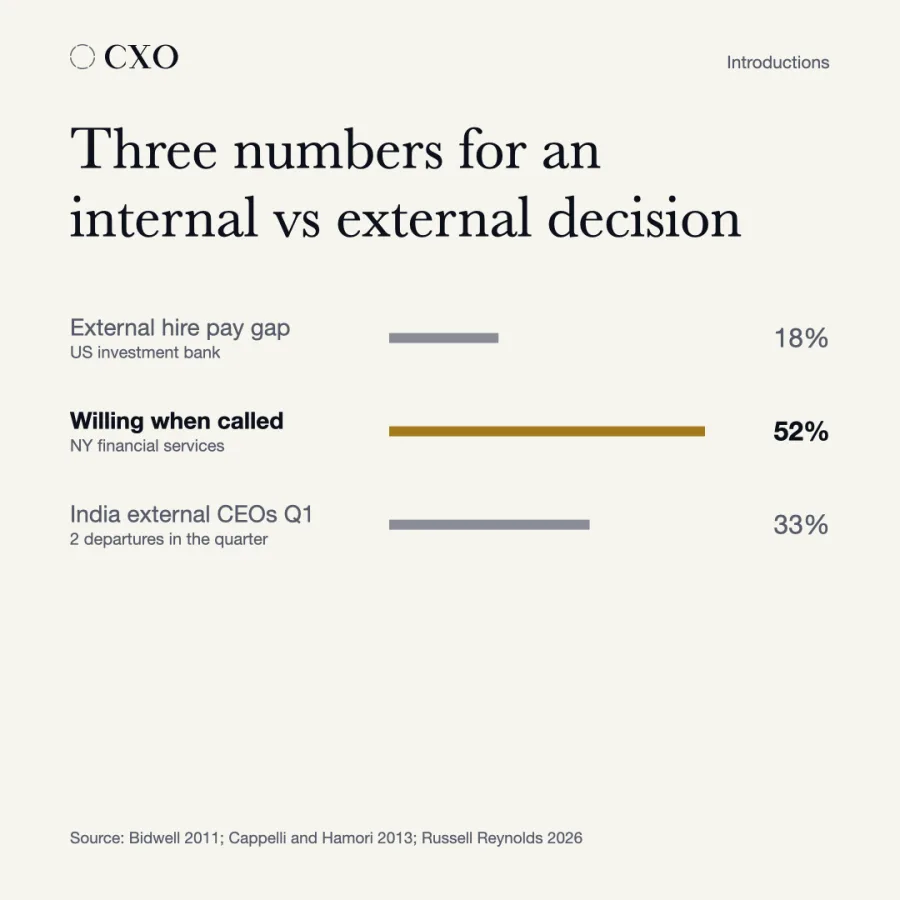
A board filling a CXO seat usually chooses between promoting from inside and paying for a search. Matthew Bidwell's study in Administrative Science Quarterly, published in 2011, makes the case for caution about outsiders. At the US investment banking arm of a financial services company from 2003 to 2009, external hires were initially paid around 18% more than people promoted into similar jobs, performed significantly worse for their first two years, and left more often, both voluntarily and involuntarily.
A search also changes who reaches the list. Peter Cappelli and Monika Hamori, in an NBER working paper of 2013, drew 2,000 of the 14,000 executives in one search firm's New York area financial services database. 52% were willing to be candidates when called, and executives with less certain roles and broader experience were more likely to be looking. A shortlist made of people who said yes is partly sorted by how secure they feel in their current job, and the same study found executives at firms with stronger results and higher pay than their peers were less likely to look, Knowledge at Wharton reported, so the list may under-represent the people the board most wants.
Indian data is thin at this level. Russell Reynolds' CEO Turnover Index for Q1 2026 recorded 2 CEO departures in the Nifty 50, with 33% of appointments external and outgoing CEOs averaging 11.3 years in the role against 10 globally. With so few appointments, one hire moves the external share by about a third, so the figure says little about a trend.
Neither US study covers Indian CXOs. Bidwell looked at one bank's employees across grades, and Cappelli and Hamori at one database in one city. We think the direction still carries, because the mechanism does not depend on the market: a search firm can establish who is willing to move, while someone who has worked alongside a candidate can say how that person performed.
For the next CXO vacancy we would ask three people who have seen the strongest internal candidate at work, and the same of anyone on an outside list, and then commission a search only for what those conversations leave open. An outside hire, when the board makes one, gets a written support plan for the first 24 months, the period in which Bidwell's external hires underperformed.
Sources (4)
- Bidwell, Paying More to Get Less, Administrative Science Quarterly (2011)
- Cappelli and Hamori, Who Says Yes When the Headhunter Calls? NBER Working Paper 19295 (Aug 2013)
- Russell Reynolds, 2026 Q1 CEO Turnover Index: APAC (18 May 2026)
- Knowledge at Wharton, When headhunters call, a surprising number of executives answer, 26 September 2013