
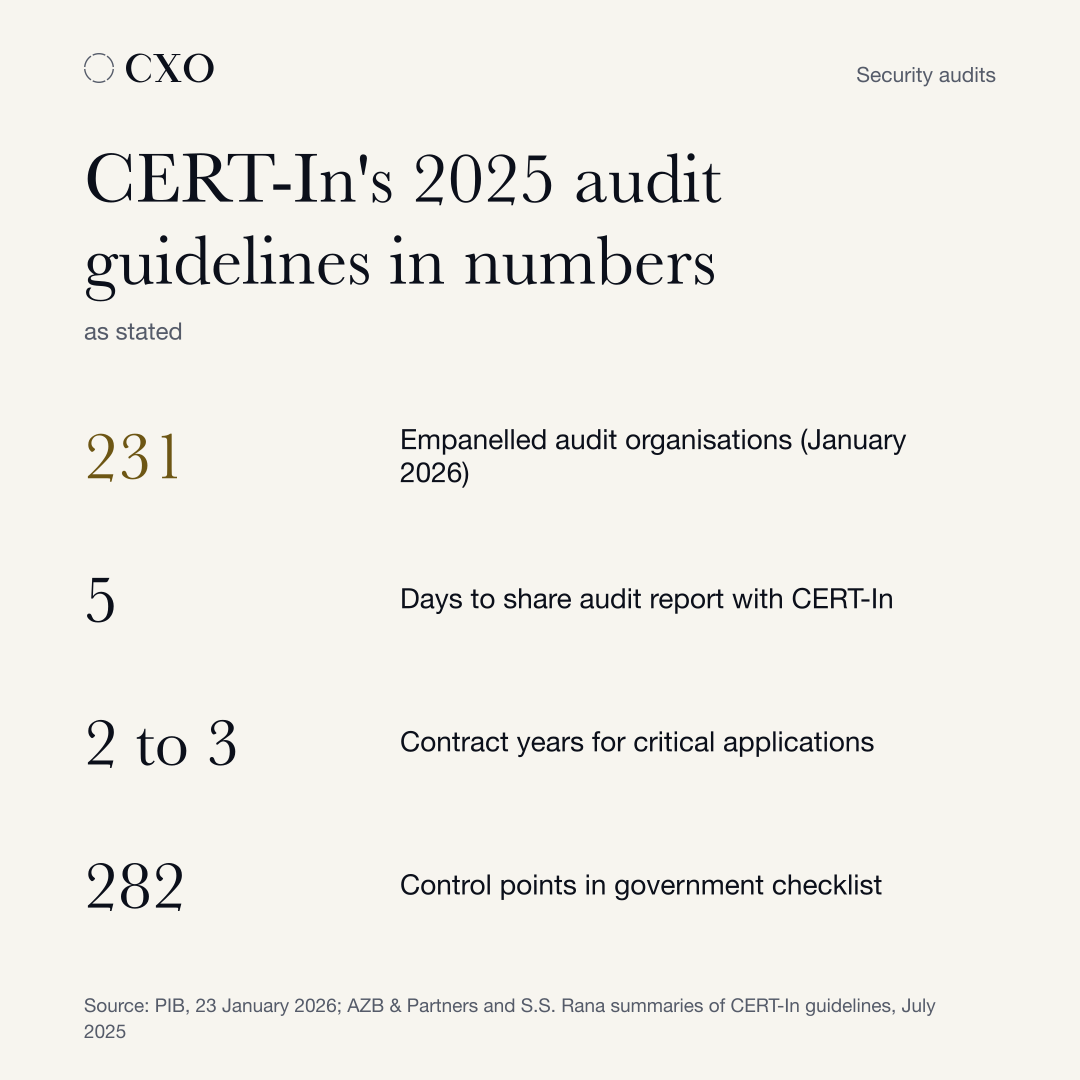
A CISO renewing a security audit contract now writes for a second reader. CERT-In's Comprehensive Cyber Security Audit Policy Guidelines, issued on 25 July 2025, require auditors to tell auditees at the start that audit metadata and reports go to CERT-In within 5 days of completion, and to report critical and high-severity vulnerabilities to both the auditee and CERT-In as soon as they are found, as reported by AZB & Partners. CERT-In's own site did not load during our research, so the requirements here are as reported by AZB, Fox Mandal and S.S. Rana.
Fox Mandal reads the guidelines as applicable to all CERT-In empanelled auditing organisations and auditee entities, and AZB says that includes organisations under mandatory audit regimes such as RBI and SEBI regulated entities. The pool is fixed: a PIB note of 23 January 2026 counts 231 empanelled audit organisations, with most audits carried out in banking and financial institutions, power and energy, and transport.
The auditee's duties are specific. AZB reports that audits must happen at least annually, and after major changes such as technology migrations. S.S. Rana reports that scope must be derived from and limited to the auditee's consolidated and updated asset inventory, that top management should approve the audit programme, and that senior management must attend the entry and exit conferences. AZB adds a signed engagement letter and a mandatory NDA, auditee data stored only on systems in India and shared with no foreign entity without written authorisation, payment that does not depend on audit outcomes, and contracts of 2 to 3 years for critical or high-reach applications.
The guidelines also close two common escape routes. Auditors should decline to audit an application that lacks secure design and development practices, telling the auditee in writing with a copy to CERT-In. The Final Outcome Report is issued only after vulnerabilities are closed and a follow-up audit of the production application is complete, and a staging-only audit must say so. For government bodies, S.S. Rana notes a mandatory checklist of 282 control points for critical systems that handle sensitive personal information.
Our judgment is that these rules will reach auditees through sector regulators that already demand CERT-In empanelled audits, even though the listed sanctions, from a watch-list to de-empanelment, fall on auditors. We are wrong if, by the end of 2027, no sector regulator has cited these guidelines in a circular or action directed at the companies being audited.
We would reconcile the asset inventory before signing, so the scope is complete and defensible. Write production systems into scope, confirm in the contract where the auditor will store your data, and leave time in the plan to fix findings before the follow-up audit.
This is based on our research into public sources and is not legal advice. Check how it applies to your company with your lawyers and advisers.
Sources (4)
- AZB & Partners, Strengthening India's cyber defence: CERT-In's new cyber security audit guidelines decoded (1 August 2025)
- Fox Mandal, Cybersecurity audits: takeaways from CERT-In's new guidelines (29 July 2025)
- S.S. Rana & Co., CERT-In ensures data privacy in cyber security audits (27 August 2025)
- Press Information Bureau, CERT-In: India's frontline defender against cyber threats (23 January 2026)