

A professional executive offered the CEO job at a promoter-run company has some evidence on their side. Spencer Stuart's study of all BSE 200 CEOs appointed from 2020 to 2025, published in February 2026, found that in family-owned, professionally run companies external CEOs often outperform internal successors, while in fully professional organisations insiders tend to do better. Performance there is total shareholder return from the year of appointment, measured against the BSE 200 index over the same period. The page we read gives no effect sizes, and this is a correlation across companies, so it describes a pattern and cannot forecast one appointment.
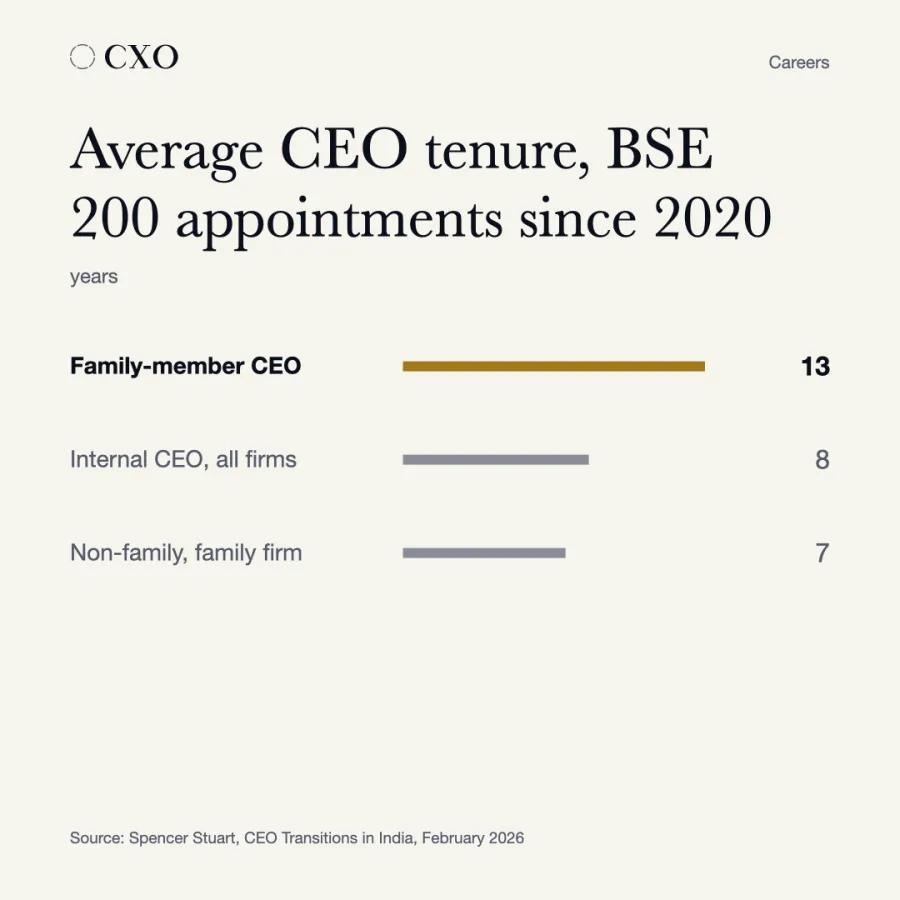
Non-family CEOs at family firms average 7 years in the job, against 13 for family members. We would read that as a fact about ownership, since a family CEO is harder to remove, and as a planning figure for an outsider, who has fewer years in which to show results the board can judge.
The predecessor is the term to fight over. Spencer Stuart's chart shows 73% of family-member CEOs stayed on the board after transition, against 15% of non-family CEOs, and its text gives 83% for the family group, so the exact figure is unsettled. On either number a family predecessor usually stays in the boardroom.
Offers like this are coming more often. Roughly one in six BSE 200 companies named a new CEO in 2025, the most since 2020, and in about half of those 33 transitions the predecessor had stepped down within three years.
Two things belong in the offer: the predecessor's board role and a written list of the decisions that are yours. The board role matters because a family predecessor usually stays in the room, and the list matters because a seven-year average leaves little time to settle who decides what after you start.