
Morgan Stanley built DevGen.AI to read old code and write plain-English specifications that developers then rewrite. Rolled out in January 2025, on OpenAI models and trained on the bank's own code, it reviewed 9 million lines and saved 280,000 developer hours, according to The Wa
Morgan Stanley built DevGen.AI to read old code and write plain-English specifications that developers then rewrite. Rolled out in January 2025, on OpenAI models and trained on the bank's own code, it reviewed 9 million lines and saved 280,000 developer hours, according to The Wall Street Journal, which we read via syndication. Those figures are the bank's and cover under six months, and full translation is still maturing.
Reading and specifying old code is the stage vendors have traditionally billed as discovery. No source we opened measures how much vendor revenue sits there.
Hours saved are harder to bank than lines reviewed. METR's late-2025 study found an 18% speedup for the 10 returning developers among its 57, on an interval that includes zero, and a 4% speedup for the 47 new recruits, also with an interval that includes zero. METR calls its own estimate a bad proxy, and its subjects did open-source work, far from a bank's legacy code.
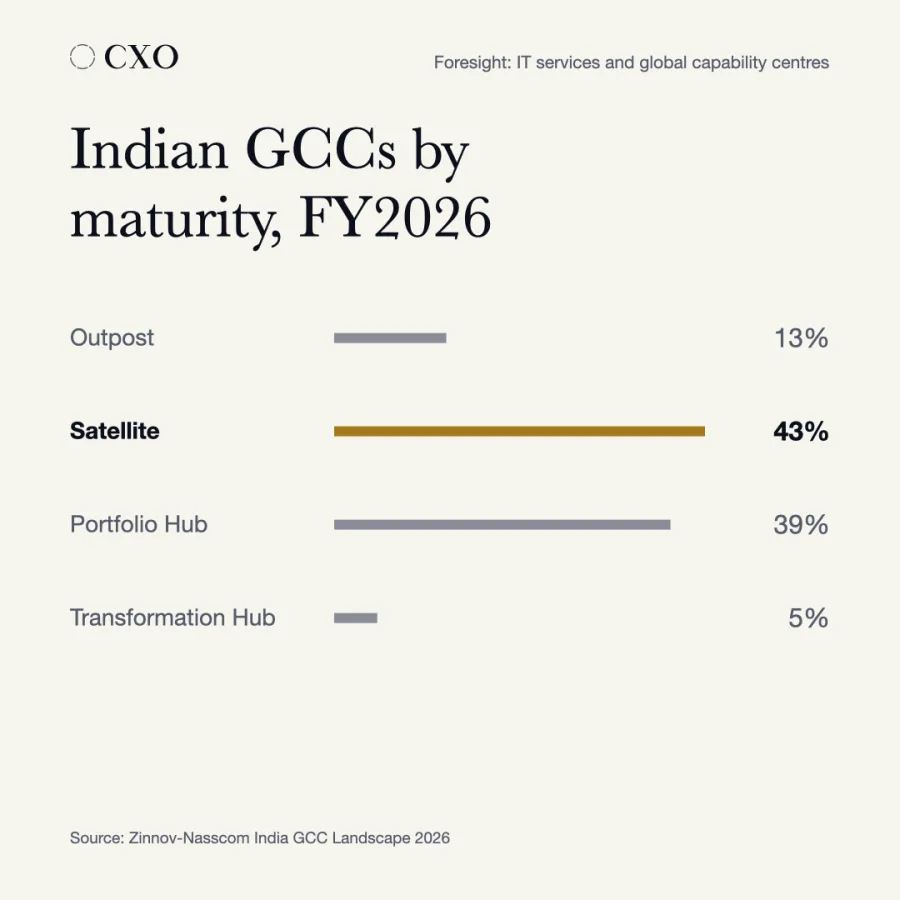
Indian centres hit a different limit. Zinnov-Nasscom's FY2026 split, from Zinnov, which calls itself "the firm that builds GCCs", puts 5% of GCCs in the Transformation Hub class and 56% in the Outpost or Satellite classes, which, on our reading, often cannot change the parent's architecture. Bank data rules may also limit where code can be processed. We expect Transformation Hubs to stay under 10% of GCCs through March 2028, because moving mandate is slower than moving code.
A GCC with the mandate can write the specification stage out of its next vendor contract. One without it has to win that argument at the parent first. Neither has grounds to book a headcount saving it has not measured.