
An owner-manager choosing a peer group for 2027 has one large randomised trial to go on, and it says to choose the group for who sits in it and whether they compete with you.
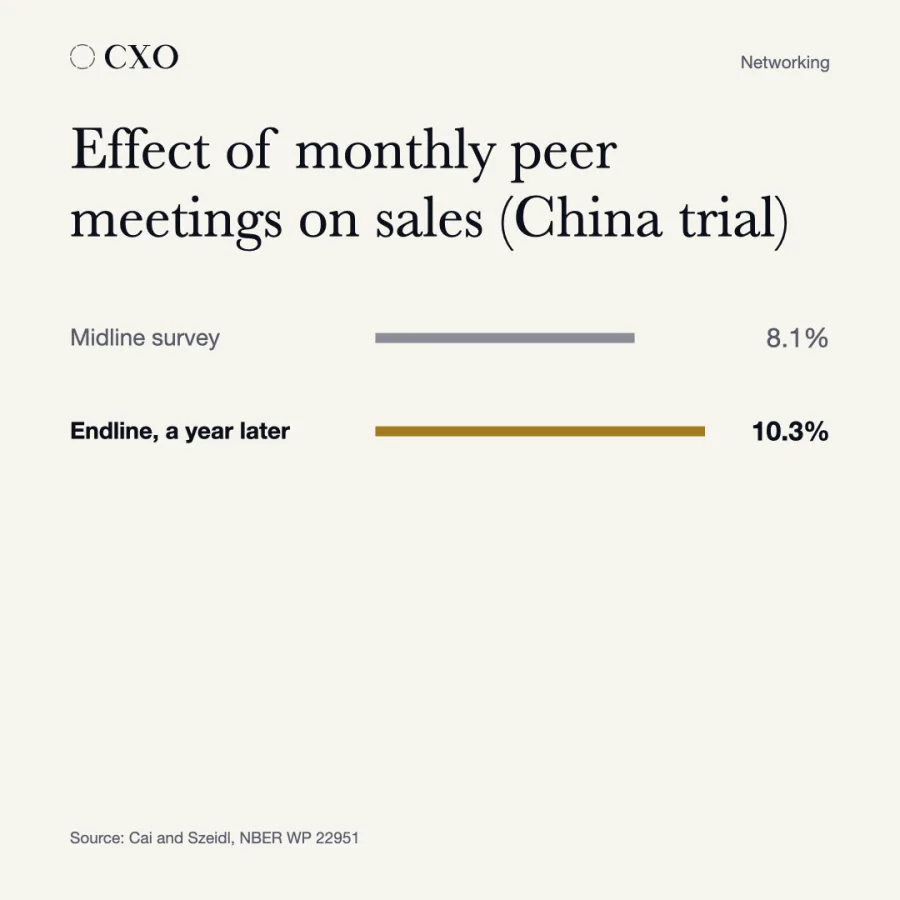
Cai and Szeidl, in the Quarterly Journal of Economics in 2018, randomly assigned 2,820 young Chinese firms either to small groups of managers who met monthly for a year or to a control group with no meetings. The meetings raised firm revenue by 8.1%, and the authors report that the gain persisted a year after the meetings stopped. Two further findings bear on the choice of group. Managers shared business information mainly when they were not competitors, and firms randomly placed with better peers grew faster.
An Indian trial adds the role of trust. Field, Jayachandran, Pande and Rigol, in the American Economic Journal: Economic Policy in 2016, gave two days of business counselling to a random sample of customers of India's largest women's bank and invited some to bring a friend. The counselling raised business activity only for those trained with a friend.
Neither sample looks like the MD of a mid-size Indian company. One covers owners of young Chinese firms, the other low-income women running small businesses. We found no Indian randomised trial of senior executive peer groups. The mechanism is what we would carry across, since a manager anywhere has reason to hold back in front of a rival and to speak more freely beside someone already trusted.
For a 2027 membership, we would pick a cross-sector group over a sector association, because in the trial information moved between non-competitors, and ask the convenor who its strongest operator is, since better peers went with faster growth. The Indian result, from low-income women whose mobility was constrained, suggests a trusted companion helps people act on advice, and that much transfers: join alongside one person you already trust. An Indian industry body could go a step further and assign members to groups at random, which would give Indian executives the local evidence that no forum can offer today.
Sources (4)
- Cai and Szeidl, Interfirm Relationships and Business Performance, Quarterly Journal of Economics 133(3), 1229-1282 (2018), abstract via EconPapers
- Cai and Szeidl, Business relationships boost firms' performance, LSE Business Review (6 September 2018), author summary of the QJE paper
- Cai and Szeidl, Interfirm Relationships and Business Performance, NBER Working Paper 22951 (December 2016)
- Field, Jayachandran, Pande and Rigol, American Economic Journal: Economic Policy 8(2), via IDEAS (2016)