
A cement, aluminium, chlor-alkali or paper company that expects to miss its 2025-26 emissions intensity target has to decide how many carbon credit certificates to buy in India's first trading sessions.
A cement, aluminium, chlor-alkali or paper company that expects to miss its 2025-26 emissions intensity target has to decide how many carbon credit certificates to buy in India's first trading sessions. The Bureau of Energy Efficiency's draft trading procedure, dated October 2026, says certificates bought through a power exchange 'shall not be eligible for resale under any circumstances'. A buyer that overestimates its shortfall can bank the surplus for its own later years under the 2025 target rules, but it cannot sell it back.
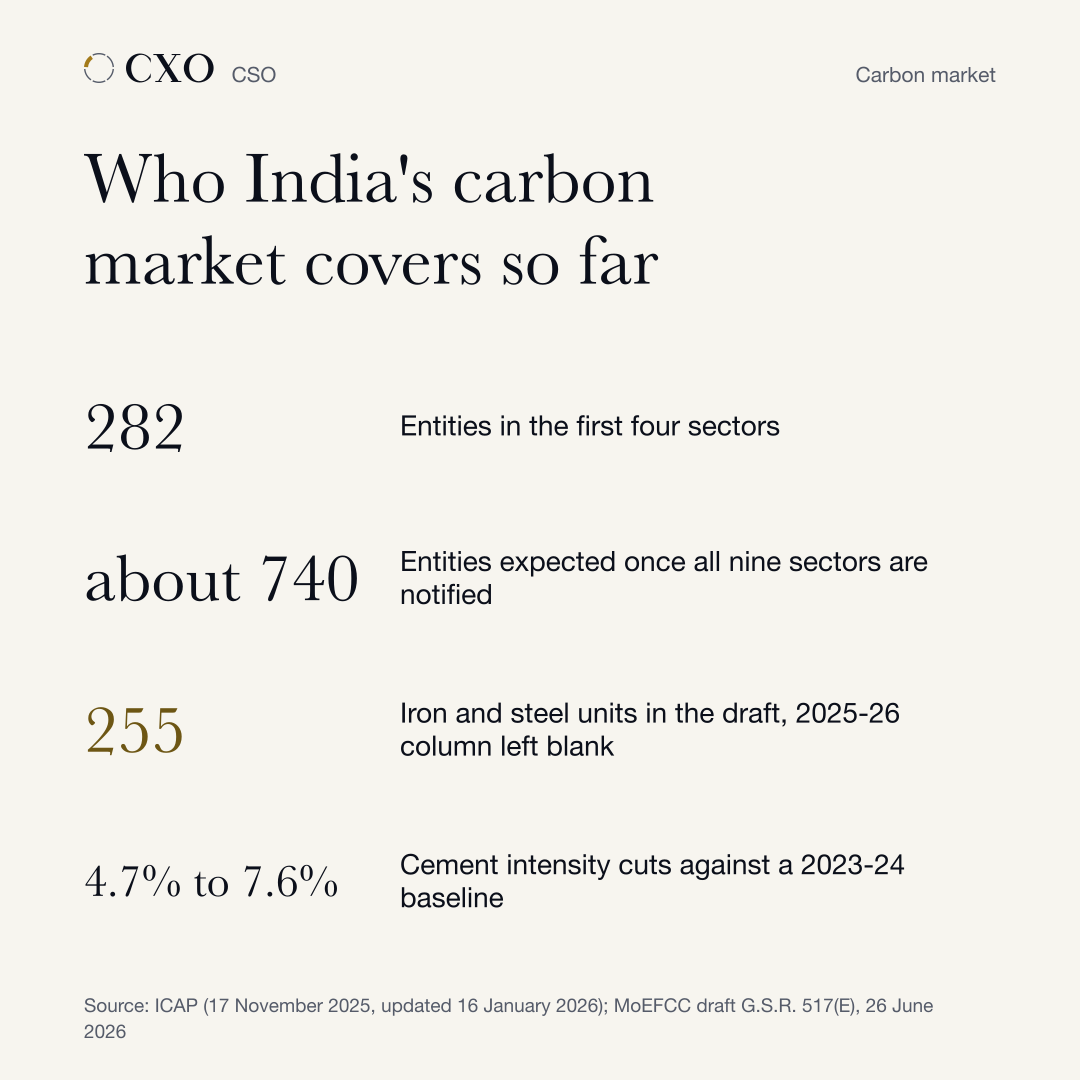
The targets bind at plant level. The Greenhouse Gases Emission Intensity Target Rules of 8 October 2025 set targets for 2025-26 and 2026-27, and an amendment of 13 January 2026 added secondary aluminium, refineries, petrochemicals and textiles. ICAP counts 282 entities in the first four sectors, with cuts against a 2023-24 baseline of 4.7% to 7.6% for cement plants, and expects about 740 once all nine sectors are notified. An entity that fails to comply faces environmental compensation of twice the average price at which certificates traded in that compliance year.
Steel arrives a year late. The environment ministry's draft notification of 26 June 2026 lists 255 iron and steel units with targets for 2026-27 only, and leaves the 2025-26 column blank. It allowed 60 days for objections, and we found no final notification as of mid-November.
The market itself is new. CERC notified its carbon credit trading regulations on 27 February 2026, Khaitan & Co reports, with monthly trading on power exchanges inside a floor and a forbearance price that CERC approves on BEE's proposal. BEE's draft provides for a closed double-sided uniform price auction. We found no report of a first trade by mid-November.
China brought its heavy industry in more gently. Its allocation plan of 16 November 2025 brought about 3,700 steel, cement and aluminium entities into the national ETS, and for 2024 each received allowances equal to its verified emissions, ICAP reports. India asks for cuts from the first compliance year, so its first sellers will be the plants that already beat their targets.
Our judgment is that first sessions will be thin and the clearing price uncertain, which matters because the non-compliance charge is set at twice that average price. We expect the first certificate trade before 31 March 2027, and we are wrong if no exchange session has cleared a trade by then.
We would buy only the verified 2025-26 shortfall in the first sessions and put the rest of the budget into cutting 2026-27 intensity, since a plant that ends up ahead of target cannot resell what it bought. Steel companies should model their 2026-27 position against the draft numbers now.
This is based on our research into public sources and is not legal advice. Check how it applies to your company with your lawyers and advisers.
Sources
- Bureau of Energy Efficiency, Draft Detailed Procedure for Transaction of Carbon Credit Certificates under Compliance Mechanism (October 2026)
- Gazette of India, Greenhouse Gases Emission Intensity Target Rules, 2025, G.S.R. 739(E), 8 October 2025 (BEE copy)
- Gazette of India, MoEFCC draft notification G.S.R. 517(E) on iron and steel targets (26 June 2026, BEE copy)
- ICAP, India notifies emission intensity targets for nine sectors under the Carbon Credit Trading Scheme (17 November 2025, updated 16 January 2026)
- Khaitan & Co, ERGO: Carbon credits enter the market (20 March 2026)
- ICAP, China releases 2024-2025 allowance allocation plan for industrial sectors in National ETS